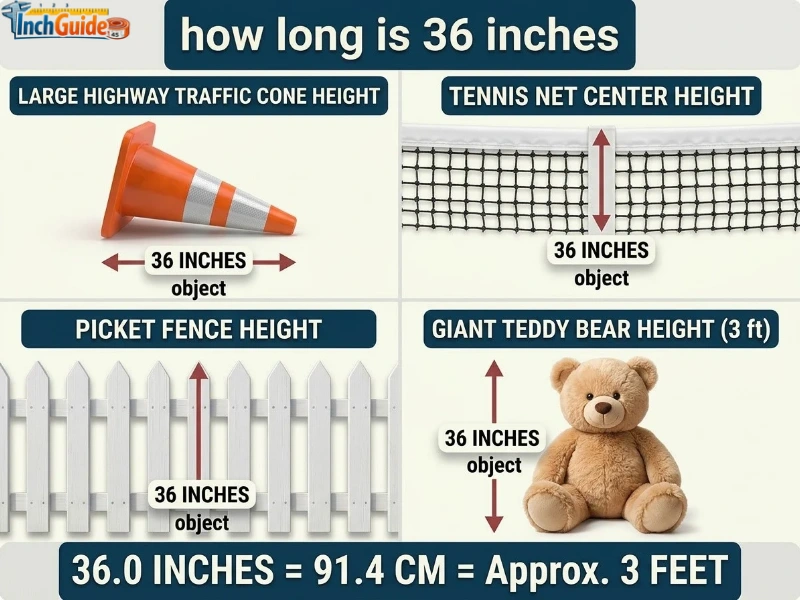

How long is 36 inches? 36 inches is exactly 3 feet, 1 yard, or 91.44 centimeters. This measurement is slightly shorter than one meter and is commonly used for fabric, sports equipment, furniture, tools, and other everyday items. A standard yardstick is one of the easiest ways to picture this length because it measures exactly 36 inches.
However, the meaning of this measurement depends on the object. For a yardstick, it describes length. For a tennis net, it describes height at the center. And for a round table, it may describe the diameter. Understanding these differences makes it easier to visualize the measurement and use it correctly.
Whether you are comparing product sizes, planning a home project, measuring fabric, or checking furniture dimensions, knowing how long thirty-six inches is can help you make better decisions. The following guide explains the conversions, compares the measurement with familiar objects, and shows you how to measure it accurately.
Related Guide: How Long Is 35 Inches?
36 Inches Conversion Table
The table below shows how 36 inches converts into other commonly used measurement units.
| Measurement Unit | Equivalent |
|---|---|
| Inches | 36 inches |
| Feet | 3 feet |
| Feet and inches | 3 feet 0 inches |
| Yards | 1 yard |
| Centimeters | 91.44 cm |
| Millimeters | 914.4 mm |
| Meters | 0.9144 m |
These conversions are exact. One foot contains 12 inches, one yard contains 36 inches, and one inch equals exactly 2.54 centimeters.
36 Inches to Feet: How Many Feet Is 36 Inches?
Thirty-six inches equals exactly 3 feet. To convert inches into feet, divide the number of inches by 12 because every foot contains 12 inches.
The calculation is simple:
36 ÷ 12 = 3 feet
There are no extra inches left over after the conversion. Therefore, 36 inches can also be written as 3 feet 0 inches.
You can understand this relationship by breaking the measurement into three equal sections:
- 12 inches equals 1 foot.
- 24 inches equals 2 feet.
- 36 inches equals 3 feet.
For example, imagine placing three standard 12-inch rulers end to end. Their combined length would be 36 inches, or 3 feet. This method provides a quick mental reference when you need to estimate the distance.
Remembering that 36 inches equals 3 feet is especially useful when reading product descriptions, measuring furniture, or working with dimensions listed in both inches and feet.
36 Inches to CM: The Exact Metric Conversion
Thirty-six inches equals exactly 91.44 centimeters. This conversion is useful when a product’s dimensions are listed in inches but you need to understand the size using the metric system.
To convert inches to centimeters, multiply the number of inches by 2.54.
The calculation is:
36 × 2.54 = 91.44 cm
The same measurement can also be expressed in millimeters and meters:
- 36 inches to centimeters: 91.44 cm
- 36 inches to millimeters: 914.4 mm
- 36 inches to meters: 0.9144 m
These values represent the same physical distance. Only the units change.
For example, if an online store lists a tabletop as 91.44 centimeters wide, that measurement is equivalent to 36 inches. A tabletop listed as 91 centimeters is very close, but it is not exactly the same length.
When converting measurements for construction, sewing, furniture placement, or other projects that require accuracy, use the full conversion rather than rounding too early.
Why 36 Inches Is Exactly One Yard
One yard is defined as exactly 36 inches. This means that 3 feet, 36 inches, and 1 yard all describe the same length.
Yards are frequently used when measuring fabric, planning sewing projects, and working with materials sold by the yard. Instead of measuring every inch separately, people can use yards as a convenient unit for longer lengths.
For example, purchasing one yard of fabric means purchasing a length of 36 inches. However, the fabric’s width is a separate measurement. A piece of fabric that is one yard long may be 45, 54, or 60 inches wide, depending on the material.
The relationship is easy to remember:
1 yard = 3 feet = 36 inches
This connection also explains why a standard yardstick is such a useful reference. Its full length represents one complete yard, making it a practical tool for visualizing and measuring this distance.
How Big Is 36 Inches in Real Life?
Thirty-six inches is 91.44 centimeters, making it slightly shorter than one meter. Since one meter equals 100 centimeters, the difference is 8.56 centimeters.
A standard yardstick provides the clearest visual reference because it measures this length directly. You can also picture a piece of fabric measured to one yard or a poster with a 36-inch side.
Other everyday objects can help you understand the size, but the direction of the measurement matters. A three-foot-tall object has the same vertical measurement as a yardstick has in length, even though the objects may have completely different shapes.
When comparing items, look for the dimension that matches your needs. If you want to know whether a table will fit across a space, its width or diameter matters. If you want to compare the height of a display, you need its vertical measurement.
The following examples show how this distance appears in different settings. Some have a defined or specified measurement, while others are approximate sizes that depend on the product.
For More: How Long Is 34 Inches?
How Long Is 36 Inches Compared to an Object? 12 Common Examples
1. Standard Yardstick Length
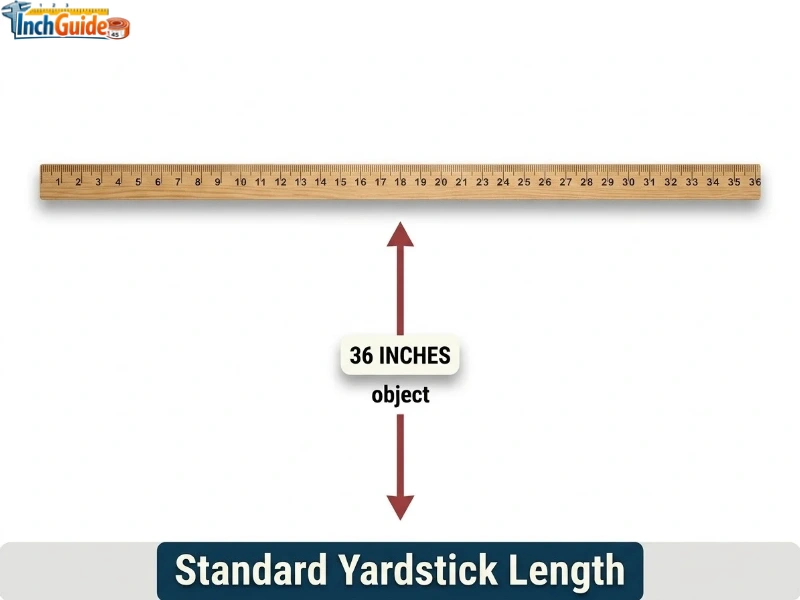
A standard yardstick is one of the most accurate examples of a 36-inch measurement. One yard equals exactly 36 inches, so a correctly marked yardstick provides a direct reference for the full distance.
Place the yardstick on a flat surface and look from one end to the other. Its complete length shows how far 36 inches extends without requiring you to combine several smaller measurements.
Yardsticks are commonly used for measuring fabric, craft materials, and flat objects. Because the tool is designed around a standard unit of length, it is more reliable than estimating the distance with your hand or comparing it with an object of uncertain size.
2. One Yard of Fabric Length
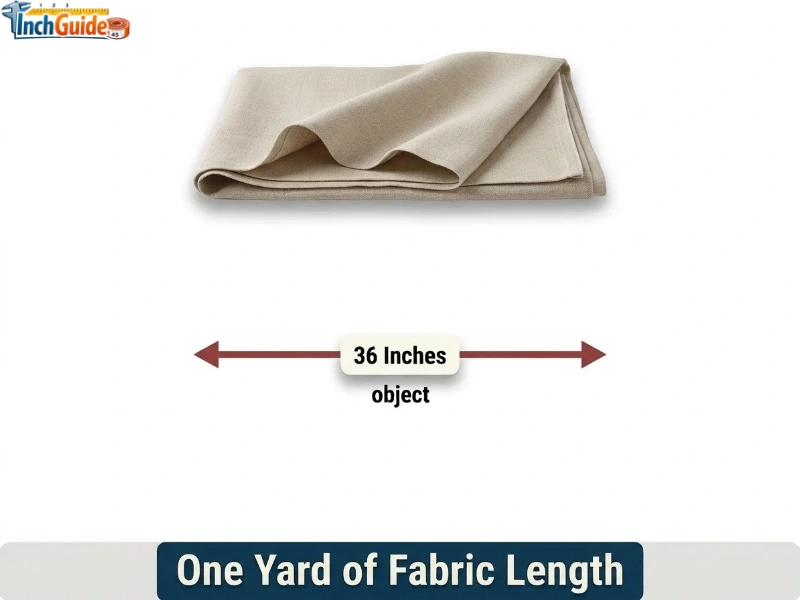
One yard of fabric measures 36 inches along its length. Fabric shops often sell material by the yard, making this measurement especially useful for sewing, quilting, clothing alterations, and craft projects.
Imagine unrolling fabric across a cutting table and measuring 36 inches from its starting point. That distance represents one yard of fabric. It is a practical example because the measurement is used regularly in real-world shopping and making activities.
The width of the fabric is separate from its length. A piece measuring one yard long may have a much greater width, depending on the type of fabric. Always check both dimensions when buying material for a specific project.
3. Tennis Net Center Height
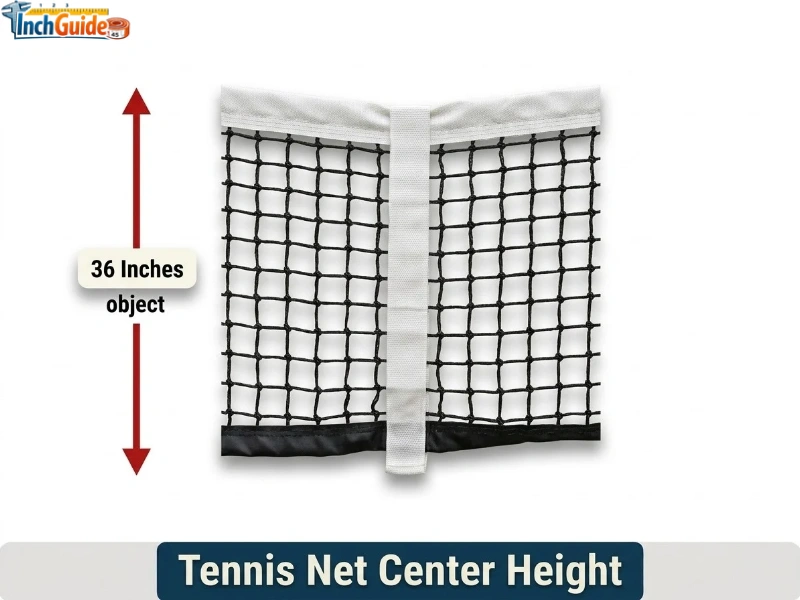
A regulation tennis net measures 36 inches high at the center. The International Tennis Federation specifies a center height of 3 feet, while the net is higher at the posts.
This is a useful example of a vertical measurement in sports. When you stand beside the middle of a properly installed tennis net, its top edge is three feet above the playing surface.
The center measurement is important because the net does not remain at the same height across its entire width. Its posts are positioned higher to maintain the correct tension and shape.
For visualizing 36 inches, focus on the net’s center height rather than its height at the ends. This example shows how a familiar sports feature can help you picture a three-foot vertical distance.
4. Large Highway Traffic Cone Height
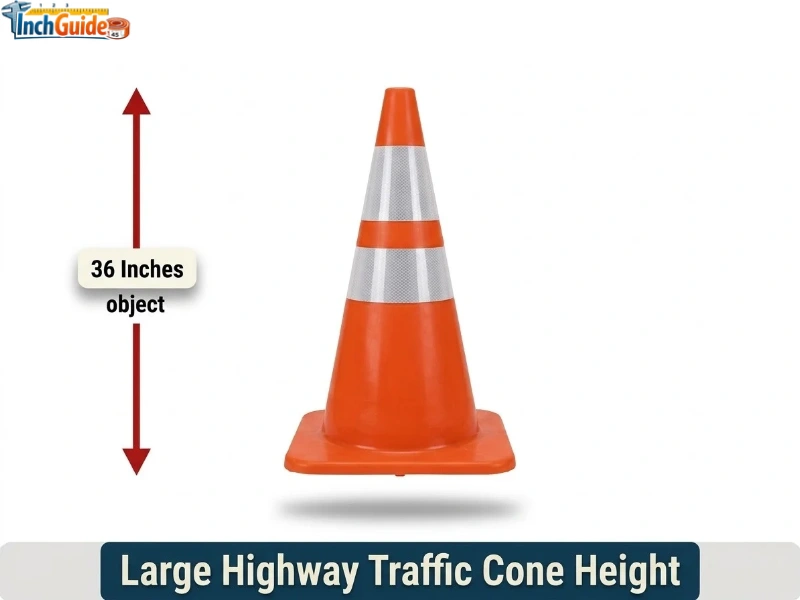
Some large traffic cones are approximately 36 inches tall. These cones are used in roadwork zones, temporary traffic control areas, and other locations where drivers need a clear visual warning.
A three-foot cone provides a helpful comparison for understanding the height of a vertical object. Its bright color and reflective bands can make it easier to notice from a distance, particularly when it is placed along a roadway.
However, traffic cones are manufactured in several sizes, and the required size depends on the application and applicable standards. Not every large highway cone is exactly 36 inches tall. Treat this as an approximate comparison unless the manufacturer’s specifications confirm the precise height.
5. Heavy-Duty 36-Inch Pipe Wrench

A heavy-duty pipe wrench is available in a 36-inch size. Plumbers and other tradespeople use these tools to grip and turn pipes and fittings. Their long handles provide leverage when working with large or tightly connected components.
A wrench listed as 36 inches gives you an example of a long hand tool that can extend across a three-foot distance. The measurement refers to the tool’s size, not the diameter of the pipe it can grip.
Actual dimensions and jaw capacity depend on the manufacturer and model. If you are buying a wrench for a particular job, check the product specifications instead of relying on its nominal size alone.
Smaller pipe wrenches are also widely available, so this comparison applies specifically to a model sold in the 36-inch size category.
6. Standard Large Poster Print Height

A poster measuring 24 × 36 inches has one side that is 36 inches long. When displayed vertically, the 36-inch side can represent the poster’s height, while the other side measures 24 inches.
This format is commonly used for promotional prints, event posters, artwork, and decorative displays. It provides a useful visual reference for understanding how a 36-inch measurement can describe one side of a flat object.
The orientation determines whether the 36-inch side is the height or width. A poster displayed horizontally may be 36 inches wide and 24 inches tall. The measurements remain unchanged even though the poster is turned.
When ordering a print, check the listed dimensions and orientation to ensure that it fits your intended display space.
7. Science Fair Tri-Fold Board Height
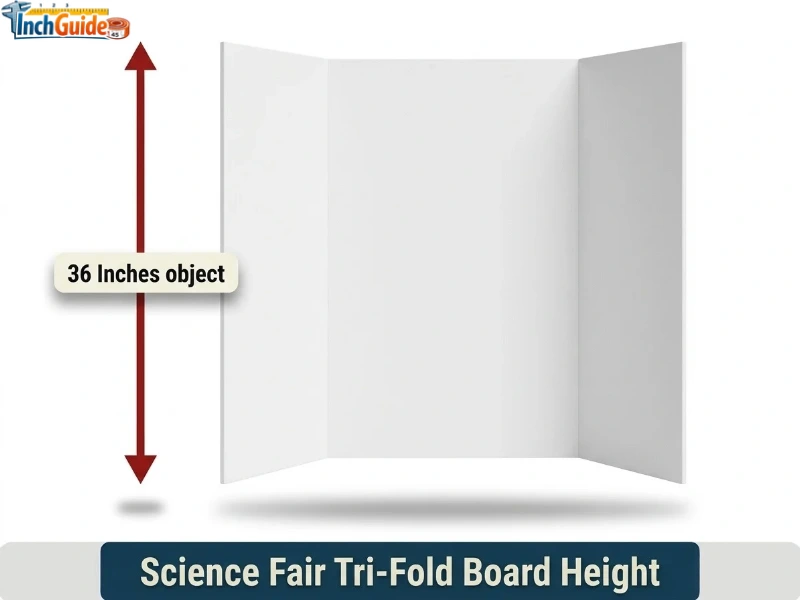
A science fair tri-fold board may be sold in a size measuring 36 × 48 inches. If the 36-inch side is positioned vertically, it provides a three-foot-high display surface.
Students use these boards to present experiments, research projects, charts, photographs, and written explanations. The folding side panels help the board stand on a table and make it easier to transport between home, school, and an exhibition area.
This example is useful when picturing a three-foot display, but board dimensions vary by manufacturer. Some products have different heights and widths, so confirm the package specifications before using a particular board as an exact measurement reference.
The important detail is that a board specified as 36 inches tall has a vertical dimension of three feet.
8. Men’s 400-Meter Hurdle Height
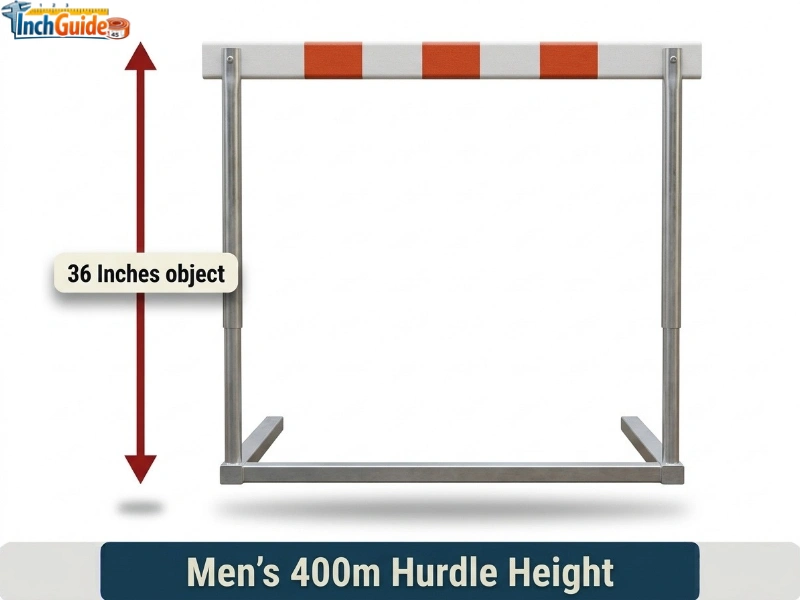
In men’s 400-meter hurdles, the official hurdle height is 91.4 centimeters, which is approximately 36 inches.
This is another sports-related example of a vertical measurement. Athletes run around a standard track while clearing a series of hurdles set at the required height.
The metric value converts to approximately 36 inches. It is better to describe the hurdle as approximately 36 inches tall rather than exactly 36 inches because the official specification is expressed in centimeters.
Hurdle heights differ between events, so this comparison specifically refers to the men’s 400-meter hurdles rather than all track-and-field hurdles.
9. Minimum Accessible Route Width

In the United States, accessibility standards specify a minimum clear width of 36 inches for many accessible walking surfaces, subject to stated exceptions and other requirements. This measurement refers to the usable space available for movement, not necessarily the overall distance between the outer faces of the walls.
This example shows how a 36-inch measurement can describe width rather than length or height. It is relevant when planning an accessible route or checking whether furniture and other obstacles reduce the space available for movement.
The exact requirements depend on the type and location of the route. Doorways, turning spaces, and other areas may be subject to additional rules or exceptions. Therefore, 36 inches should not be treated as a universal width requirement for every hallway.
Visit Also: How Long Is 33 Inches?
10. Small Round Dining Table Diameter
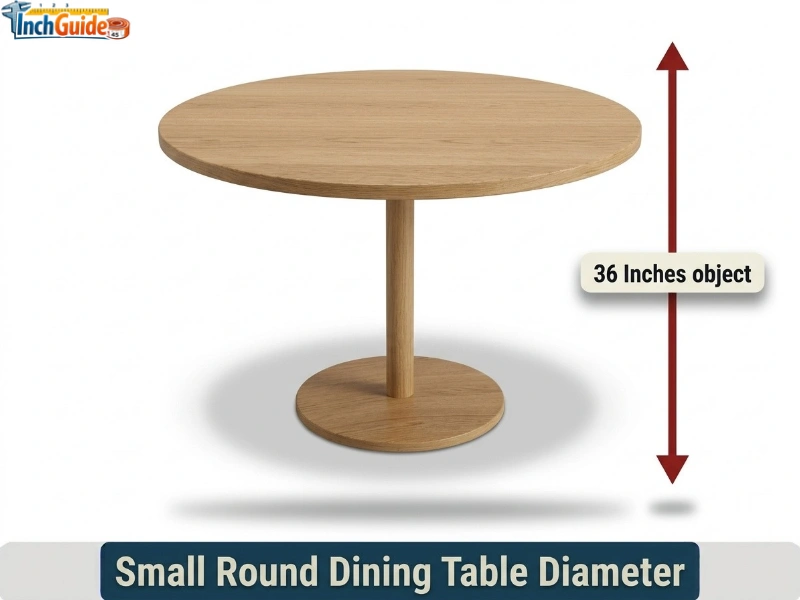
A small round dining table may have a diameter of about 36 inches. The diameter is the straight-line distance from one side of the circular tabletop to the opposite side, passing through its center.
Imagine measuring across the tabletop from its outer edge to the opposite edge. If the result is 36 inches, the table has a diameter of three feet.
This measurement can help you decide whether a table will fit in a compact dining area, breakfast nook, or small kitchen. However, the table’s actual suitability depends on the available floor space and the room needed for chairs.
Round dining tables are sold in different sizes, so check the manufacturer’s dimensions before purchasing one. The 36-inch example is a common size reference, not a universal measurement for all small dining tables.
11. Picket Fence Height

A short garden picket fence may stand about 36 inches tall. Three-foot fencing is often used for decorative boundaries, garden borders, and other areas where a low fence helps define a space without creating a tall visual barrier.
Imagine a fence panel standing beside a yardstick. If both are approximately the same height, the fence is close to 36 inches tall. This comparison can help when planning a garden layout or estimating how a fence will look beside plants and outdoor furniture.
Picket fences come in a range of heights, and some are designed for decoration while others serve different boundary purposes. Treat 36 inches as an approximate reference and measure the specific fence panel when accuracy matters.
12. Giant Teddy Bear Height

A giant teddy bear advertised as three feet tall is approximately 36 inches high. This size is common among large plush toys intended as gifts or decorative pieces for bedrooms and playrooms.
The height is generally measured from the bottom of the toy to the top of its head. However, the exact measurement method may vary by seller, and a soft toy may compress or change shape when it is sitting or leaning.
A three-foot teddy bear offers an approachable visual comparison for children and adults. Nevertheless, not every giant teddy bear measures 36 inches, so check the product listing before using a particular toy as a measurement reference.
Does 36 Inches Describe Length, Width, Height, or Diameter?
A measurement of 36 inches can describe length, width, height, or diameter. The number identifies the distance, while the dimension name explains which direction is being measured.
- Length: The distance from one end of an object to the other, such as the length of a yardstick.
- Width: The distance across an object or the usable space between two boundaries, such as the clear width of an accessible route.
- Height: The vertical distance from the bottom to the top, such as the height of a traffic cone.
- Diameter: The distance across a circle through its center, such as the diameter of a round dining table.
These terms are not interchangeable. A table with a 36-inch diameter is not necessarily 36 inches tall. Similarly, a poster’s 36-inch side may describe its width or height depending on its orientation.
Before comparing two objects, make sure you are comparing the same type of dimension. This is particularly important when checking product specifications or deciding whether an item will fit into a particular space.
How Tall Is 3 Feet in Real Life?
Three feet is the same as 36 inches, or 91.44 centimeters. When this measurement describes height, it represents the vertical distance from the bottom of an object to its top.
A three-foot teddy bear is one example of this height. A traffic cone advertised as 36 inches tall can provide another approximate comparison. The center of a regulation tennis net is also 3 feet above the playing surface.
These examples help you visualize a vertical distance without needing to imagine a horizontal ruler. However, their measurements are not all equally exact. A tennis net’s center height follows an official specification, while the height of a teddy bear or traffic cone depends on the particular product.
When measuring an object at home, identify the exact starting and ending points. Some products have handles, feet, or raised bases that affect their overall height. Checking the complete height is important when you need an accurate measurement.
How to Measure 36 Inches Accurately
A tape measure is one of the easiest tools for measuring 36 inches. Follow these steps to obtain a reliable result:
- Place the starting end of the tape at the point where the measurement begins.
- Extend the tape in a straight line toward the other endpoint.
- Locate the 36-inch mark on the tape.
- Keep the tape straight and avoid pulling it diagonally across the object.
- Mark the endpoint if you need to cut, install, or position something.
- Recheck the measurement before making any permanent changes.
If the tape includes both inches and centimeters, make sure you are reading the correct scale. The 36-inch mark corresponds to 91.44 centimeters.
For horizontal measurements, keep the tape aligned with the intended direction. For vertical measurements, use a level or another suitable tool if the object must be positioned straight.
Accurate measuring is especially important when cutting materials, installing fixtures, or checking whether an item will fit into a limited space. Even a small error can cause problems when several parts must align.
See Also: How Long Is 32 Inches?
How to Measure 36 Inches Without a Tape Measure
If you do not have a tape measure, a standard yardstick is an excellent alternative because one yard equals exactly 36 inches. Place it along the distance you want to measure and align one end carefully with the starting point.
You can also use a 12-inch ruler three times. Follow this process:
- Align the ruler’s starting point with the beginning of the measurement.
- Mark the ruler’s endpoint after the first 12 inches.
- Move the ruler forward, starting at the mark you just made.
- Repeat the process until you have measured three complete sections.
Three 12-inch sections add up to 36 inches. However, take care when moving the ruler because gaps or overlaps can introduce errors.
A piece of fabric that has already been measured to one yard can also provide a reference. Avoid relying on hand spans or guesses when precision matters, especially for cutting, construction, furniture placement, or safety-related measurements.
What to Check Before Buying a 36-Inch Item
A product described as 36 inches may not always have an overall length of 36 inches. The number could refer to its width, height, diameter, or a nominal product size. Checking the specifications helps prevent confusion.
Before buying, consider these points:
- Confirm the dimension: Check whether 36 inches refers to length, width, height, or diameter.
- Read all listed measurements: A product described as 24 × 36 inches has two different side dimensions.
- Check the manufacturer’s specifications: Product sizes can vary by brand and model.
- Understand nominal dimensions: Some advertised sizes are standard product categories rather than exact finished measurements.
- Allow room for installation: Furniture, tools, and fixtures may need additional clearance.
- Check the units: Make sure the listing uses inches, feet, or centimeters as expected.
- Consider how the item will be used: The overall dimensions may differ from the usable or internal dimensions.
For example, a 36-inch round table has a diameter of 36 inches, but its height may be much smaller. A 36-inch-wide piece of furniture also needs enough space around it if it is going to be moved, opened, or installed.
If the exact size is important, use the manufacturer’s technical specifications or measure the actual item. This is more reliable than assuming every product described as 36 inches has precisely the same dimensions.
Explore more measurement guides for easy size comparisons.
- How Long Is 31 Inches?
- How Long Is 30 Inches?
- How Long Is 29 Inches?
- How Long Is 28 Inches?
- How Long Is 27 Inches?
FAQs
1. How Many Feet Is 36 Inches?
Thirty-six inches equals exactly 3 feet. Since one foot contains 12 inches, dividing 36 by 12 gives 3 feet.
2. What Is 36 Inches in Centimeters?
Thirty-six inches equals exactly 91.44 centimeters. Multiply 36 by 2.54 to convert inches into centimeters.
3. Is 36 Inches Exactly One Yard?
Yes. One yard is exactly 36 inches, which is also equal to 3 feet. This conversion is commonly used when measuring fabric and other materials.
4. How Many Millimeters Are in 36 Inches?
Thirty-six inches equals 914.4 millimeters. This is because 91.44 centimeters multiplied by 10 equals 914.4 millimeters.
5. Is 36 Inches Shorter Than One Meter?
Yes. Thirty-six inches equals 91.44 centimeters, while one meter equals 100 centimeters. Therefore, 36 inches is 8.56 centimeters shorter than one meter.
6. How Tall Is 36 Inches in Feet?
When 36 inches describes height, it equals exactly 3 feet. A three-foot object has a vertical measurement of 36 inches from its bottom to its top.
7. What Common Objects Are About 36 Inches Long?
A yardstick and one yard of fabric provide exact references for this length. Other examples, such as a 36-inch pipe wrench or the longer side of a 24 × 36-inch poster, depend on the item’s stated dimensions.
8. How Do You Measure 36 Inches Without a Tape Measure?
Use a standard yardstick or measure three consecutive 12-inch sections with a ruler. Align each new starting point carefully with the previous endpoint to reduce errors.
9. Does a 36-Inch Product Always Have an Actual Size of 36 Inches?
No. Some products are made to a specified 36-inch dimension, while others use a nominal or approximate size. Check the manufacturer’s measurements to confirm the item’s actual dimensions.
10. What Is the Difference Between 36 Inches Long and 36 Inches Wide?
Both measurements describe a distance of 36 inches, but they refer to different directions. Length usually measures an object from end to end, while width measures across it from side to side.
Conclusion
Thirty-six inches equals exactly 3 feet, 1 yard, or 91.44 centimeters. It is also equal to 914.4 millimeters and 0.9144 meters. Remembering that one yard contains 36 inches makes this measurement easy to understand and convert.
A yardstick and one yard of fabric provide direct examples of the length. Other comparisons, such as the center height of a tennis net, the longer side of a large poster, and the diameter of a small round table, show how the same measurement can apply to objects with different shapes and purposes.
The key is to identify what the measurement describes. Length, width, height, and diameter are different dimensions, even when they share the same number. Some products have exact specified dimensions, while others are sold in approximate or nominal sizes.
When you need a quick estimate, familiar objects can help you picture the distance. When accuracy matters, use a measuring tool and verify the product’s specifications. This approach makes it easier to compare sizes, plan projects, and understand dimensions with confidence.