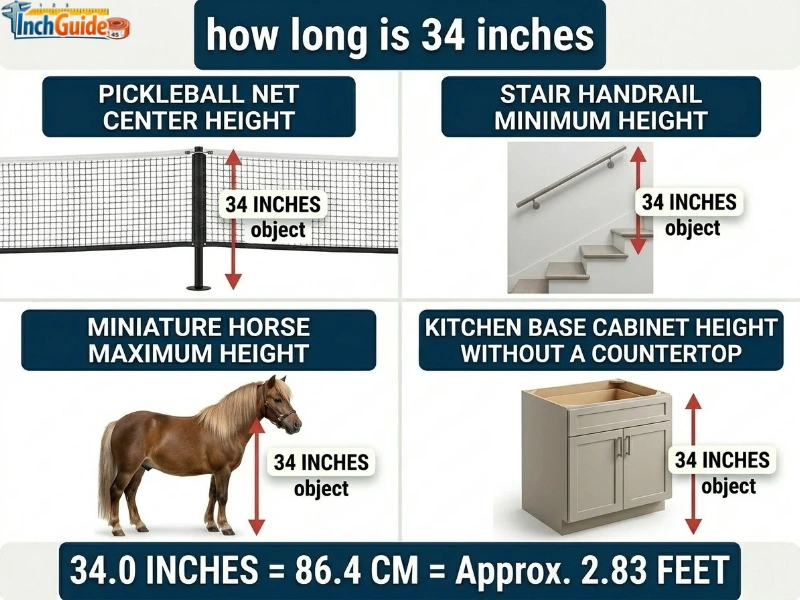

34 inches is equal to 86.36 centimeters, 863.6 millimeters, or 2 feet 10 inches. It is just 2 inches shorter than 3 feet. In everyday life, this length is close to the center height of a regulation pickleball net, the height of some kitchen base cabinets before the countertop is added, and the height of many standard 55-gallon drums.
The easiest way to picture this measurement is to compare it with familiar objects. Some examples follow official standards, while others are approximate dimensions that vary by model or manufacturer. Knowing the difference helps you visualize the size without assuming every object is exactly 34 inches long or tall.
Related Guide: How Long Is 33 Inches?
34 Inches Conversion Table
| Measurement Unit | Equivalent of 34 Inches |
|---|---|
| Centimeters | 86.36 cm |
| Millimeters | 863.6 mm |
| Meters | 0.8636 m |
| Feet | 2.8333 ft |
| Feet and inches | 2 ft 10 in |
| Yards | 0.9444 yd |
Quick answer: 34 inches equals exactly 86.36 centimeters and 2 feet 10 inches. It is 2 inches shorter than 3 feet.
To convert inches to centimeters, multiply by 2.54. To convert inches to decimal feet, divide by 12.
How Big Is 34 Inches in Real Life?
Imagine a vertical measurement that reaches nearly 3 feet above the floor. That is approximately how tall 34 inches is. If you are measuring horizontally, it is a little longer than a 30-inch section of a yardstick.
This measurement appears in several everyday settings, including kitchens, sports equipment, furniture, pet products, and industrial containers. For example, a regulation pickleball net is 34 inches high at its center, while some kitchen base cabinets are around 34.5 inches tall before a countertop is installed.
However, the direction of the measurement matters. A cabinet’s height is measured from the floor to its top, while the length of a golf putter is measured along the club. A fan’s blade span is measured across the circular area covered by its blades. These dimensions can be close to 34 inches, but they describe different things.
34 Inches to CM: The Exact Conversion
34 inches equals 86.36 centimeters. To convert inches into centimeters, multiply the number of inches by 2.54 because one inch is exactly 2.54 centimeters.
The calculation is:
34 × 2.54 = 86.36 cm
This is an exact conversion, not an estimate. You can use it when measuring furniture, checking product dimensions, planning a home project, or comparing an object described in inches with measurements given in centimeters.
Here are a few useful reference points:
- 30 inches equals 76.2 cm.
- 32 inches equals 81.28 cm.
- 34 inches equals 86.36 cm.
- 36 inches equals 91.44 cm.
The differences become easier to understand when you compare nearby measurements. A 34-inch object is 5.08 cm longer than a 32-inch object and 5.08 cm shorter than a 36-inch object.
34 Inches to Feet: How Many Feet Is 34 Inches?
34 inches equals approximately 2.83 feet, or exactly 2 feet and 10 inches when expressed in feet and remaining inches.
To convert inches into decimal feet, divide the number of inches by 12. There are 12 inches in one foot, so the calculation is:
34 ÷ 12 = 2.8333 feet
For everyday descriptions, 2 feet 10 inches is usually easier to picture than 2.8333 feet. Decimal feet are often more useful in calculations, technical drawings, and measurement software.
The two formats describe the same length:
- Decimal format: approximately 2.83 feet.
- Feet-and-inches format: 2 feet 10 inches.
- Metric format: 86.36 centimeters.
Do not confuse 2.83 feet with 2 feet and 83 inches. The decimal part represents a fraction of a foot, not a separate number of inches.
How Tall Is 34 Inches?
When a measurement describes height, 34 inches means the vertical distance from the bottom to the top is 2 feet 10 inches. It may describe a piece of furniture, a railing, a container, or a child’s height, depending on the context.
For instance, a kitchen base cabinet without its countertop can be approximately 34 to 34.5 inches tall. A stair handrail may also be installed at a height that begins at 34 inches, depending on the applicable building code and the type of property. These examples show how the same measurement can be used in different settings.
Height measurements need a clear starting and ending point. A cabinet is generally measured from the floor to its top surface. A stair handrail is measured vertically from the relevant stair nosing line or walking surface, according to the applicable code. A child’s standing height is measured from the floor to the top of the head.
The context matters because two objects can both measure 34 inches without being measured in the same way.
For More: How Long Is 32 Inches?
How Tall Is 34 Inches in Feet?
34 inches is 2 feet 10 inches tall, which is about 2.83 feet in decimal form. This is a useful conversion when a product description gives its height in inches but you normally picture vertical measurements in feet.
To visualize the height, think of a point 2 feet above the floor, followed by another 10 inches. The total is just short of 3 feet, which equals 36 inches.
This is also why it helps to distinguish between a height and a length. Saying that a cabinet is 34 inches tall means it rises 34 inches from its base to its top. Saying a golf club is 34 inches long refers to the club’s overall length, not how high it stands when held or placed at an angle.
If you are measuring something for installation, leave room for any parts that add to its overall height, such as a countertop, feet, lid, or mounting hardware.
How Long Is 34 Inches Compared to an Object? 12 Common Examples
The following examples use official specifications where available and approximate dimensions where products naturally vary. They are intended to help you visualize the measurement, not to replace a ruler or a manufacturer’s dimension sheet.
1. Pickleball Net Center Height

A regulation pickleball net is 34 inches high at the center, measured from the playing surface to the top of the net. At the sidelines, the top of the net is 36 inches high. This difference creates the slight dip across the middle of the net. The official USA Pickleball rulebook specifies these measurements, with a small permitted tolerance.
This is one of the strongest comparisons because the center height is an official sports specification rather than a general estimate. If you stand beside a regulation net, its middle section gives you a practical visual reference for the height.
Remember that the 34-inch measurement applies to the center, not the net posts or the sides. Measuring the wrong part would give you a different result.
2. Stair Handrail Minimum Height

Under the 2021 International Residential Code, a stair handrail is generally required to be between 34 and 38 inches high, measured vertically from the sloped plane adjoining the stair tread nosings. Therefore, 34 inches represents the lower end of that specified range, not the required height in every building or jurisdiction.
Picture a handrail running beside a staircase. Its height is measured upward from the line connecting the front edges of the stair treads, rather than from an arbitrary point on the floor. That distinction is important when comparing the code measurement with an object standing on a flat surface.
Building requirements can vary by location, building type, and adopted code edition. If you are installing a handrail, check the rules that apply to your property instead of relying on this comparison alone.
3. Miniature Horse Maximum Height
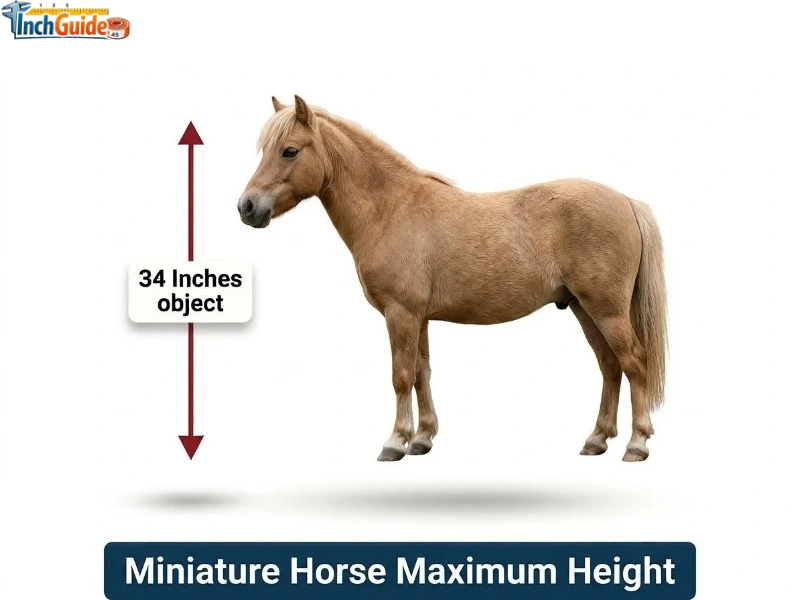
The American Miniature Horse Association sets a maximum mature height of 34 inches for horses eligible under its breed standards. The measurement is taken at the withers, near the base of the last hairs of the mane, with the horse standing correctly on a level surface.
This gives you a real animal-related example of the measurement. A miniature horse that meets this standard reaches no more than 34 inches at the specified measuring point. It is not measured to the top of its head or ears.
The qualification matters because the 34-inch limit relates to a particular association’s registration standard. It does not mean every small horse or pony has a height of 34 inches.
4. Kitchen Base Cabinet Height Without a Countertop
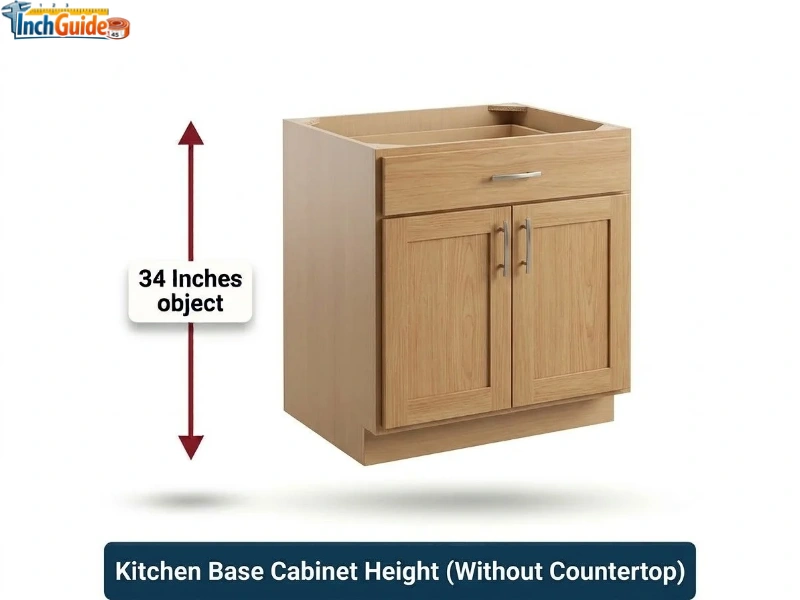
A standard kitchen base cabinet is commonly around 34 to 34.5 inches tall before the countertop is added. For example, a cabinet measuring 34.5 inches without the countertop would be only half an inch taller than the reference measurement. With a typical countertop installed, the total height may reach approximately 36 inches.
To picture this example, imagine the cabinet boxes and legs standing on the kitchen floor, but without the countertop covering them. Measure vertically from the floor to the top of the cabinet structure. Do not include the countertop when comparing the cabinet with 34 inches.
Cabinet dimensions vary with the manufacturer, adjustable legs, flooring, and kitchen design. If you are planning a renovation or ordering replacement cabinets, use the exact product specifications.
5. 55-Gallon Drum Height

Many standard 55-gallon steel drums stand around 34 to 35 inches tall. One manufacturer’s closed-top steel drum is listed at 34.25 inches, while other models measure about 34.5 inches or more.
A drum close to 34.5 inches tall is a useful visual comparison because it stands only half an inch above the target length. Picture a large cylindrical storage container standing upright on a flat surface. Its height is measured from the bottom to the highest point of the drum.
Not every 55-gallon drum has the same dimensions. Material, lid design, rim construction, and manufacturer can change the overall height. The drum’s diameter is a separate measurement, so do not use its width as a substitute for its height.
Visit Also: How Long Is 31 Inches?
6. Men’s Golf Putter Length
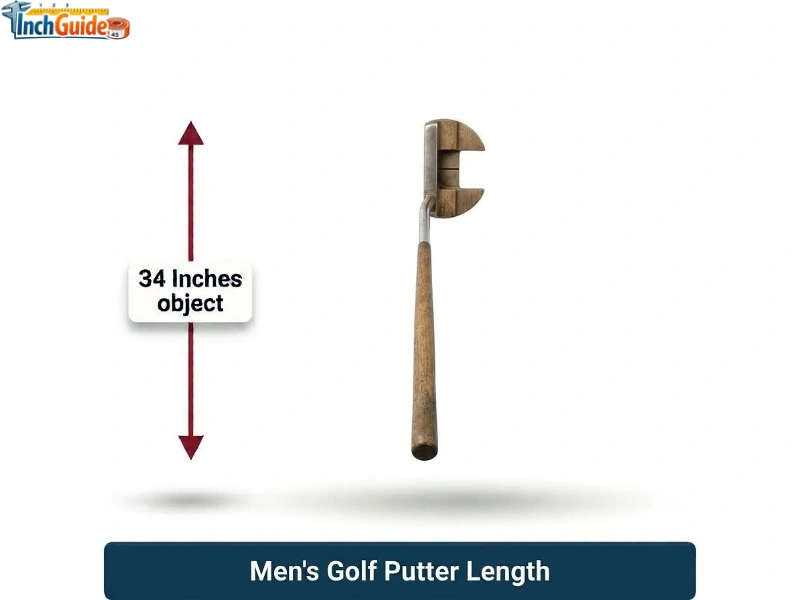
A men’s golf putter can be around 34 inches long, although there is no single length that fits every golfer. Many golfers use putters between 32 and 34 inches, while some commercially available models are longer.
A putter close to 34 inches gives you a useful example of a long, narrow piece of sports equipment. Its length is measured along the club from the grip end to the bottom of the clubhead, following the equipment’s measurement convention.
Use this as an approximate comparison, not as a universal standard for men’s putters. Golfers choose club lengths according to their posture, setup, and personal fit. Individual fitting is more important than assuming one length belongs to a particular group.
7. Average 2-Year-Old Toddler Height
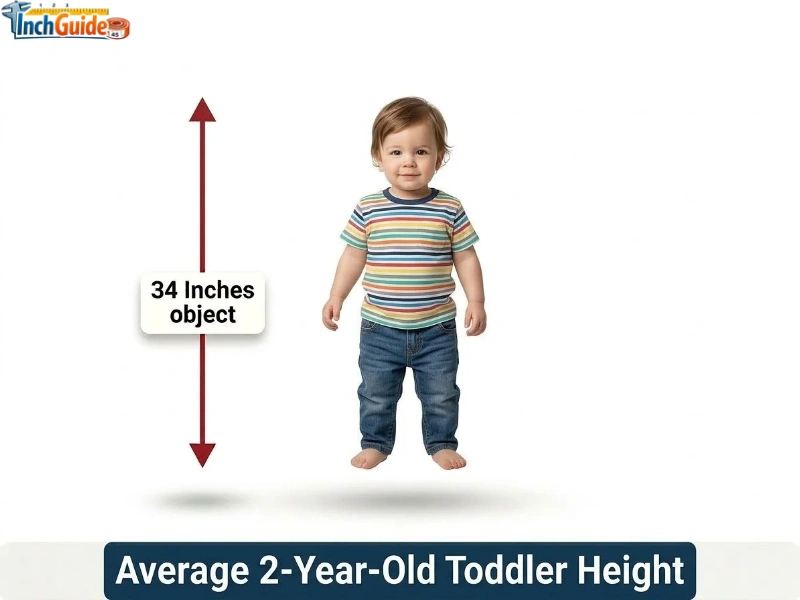
A height of around 34 inches can be a useful example when picturing a young toddler’s size. However, it should not be treated as the exact average height of every 2-year-old. Children’s heights vary with age in months, sex, genetics, and individual growth patterns.
Growth charts from the Centers for Disease Control and Prevention help track children’s stature by age and sex. They show a range of typical measurements rather than suggesting that all children of the same age should be the same height.
If you are using this example to visualize 34 inches, imagine a toddler whose standing height is close to 2 feet 10 inches. If you are checking a child’s actual growth, use an appropriate growth chart and professional guidance rather than relying on a single comparison.
8. Half-Size Acoustic Guitar Total Length
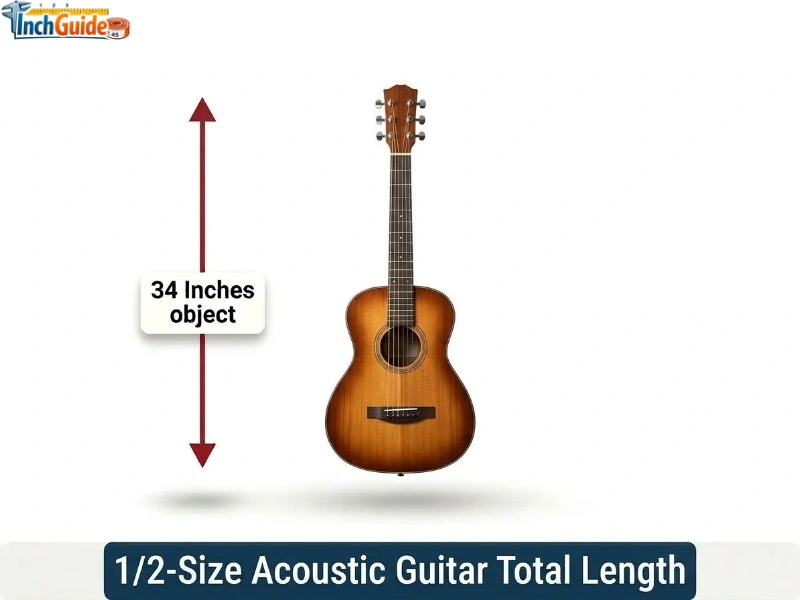
Some half-size acoustic guitars have an overall length close to 34 inches, although the exact dimension depends on the model and manufacturer. This is the total length of the instrument, not the scale length, which refers to the vibrating string length between the nut and bridge.
A guitar near 34 inches long makes a useful comparison because its body and neck form one long object. Place it carefully on a safe surface and measure from the furthest point at the body end to the end of the headstock.
Do not assume every half-size guitar is exactly 33.75 inches long. Different designs can vary, and guitar sizes are not always described using identical dimensions. Check the model’s specifications if the length needs to fit a case, shelf, or storage space.
9. Interior Length of a 36-Inch Dog Crate

A dog crate sold as a 36-inch crate may have an interior length of approximately 34 to 35 inches, depending on the frame, door, and construction. The advertised size can refer to the crate’s nominal category or its outside dimensions, so the interior space may be shorter.
This is a practical comparison when you are thinking about pet equipment. Imagine measuring the flat floor space inside the crate from the inner edge at one end to the inner edge at the other. That is the dimension that matters when checking whether a pet has enough room.
Always check the manufacturer’s interior dimensions before buying a crate. The outside length, inside length, height, and width are different measurements, and a 36-inch label does not guarantee a 34-inch interior.
10. Gas BBQ Grill Cooking Height
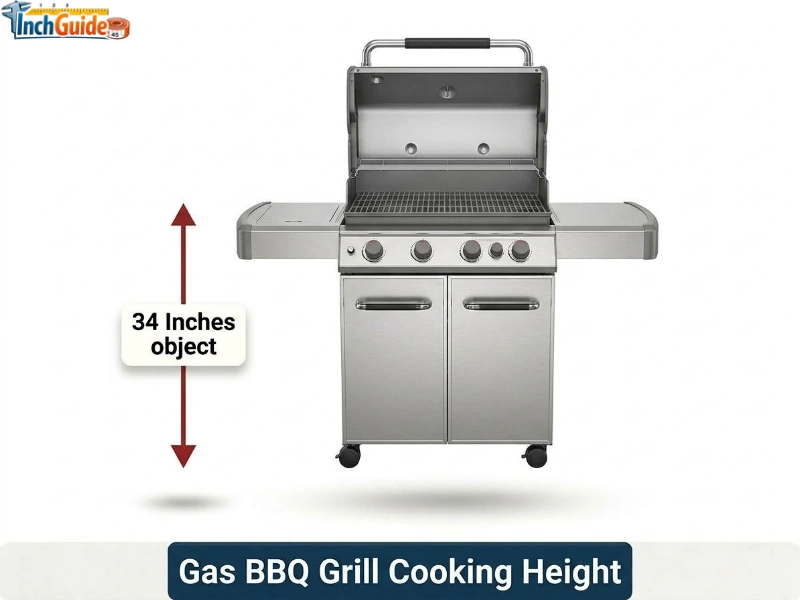
Some gas barbecue grills have a cooking surface around 34 to 36 inches above the ground, making 34 inches a reasonable approximate comparison for certain models. The height depends on the grill’s design, legs, cart, and cooking surface placement.
For this comparison, the relevant dimension is the height of the cooking grate, not the top of the lid or the highest point of the grill. The cooking surface is where food rests during grilling, so it is the useful reference if you want to visualize a 34-inch working height.
This is not a universal grill standard. Portable grills, tabletop models, and larger outdoor grills can have very different heights. If you are choosing a grill for comfort or a particular patio setup, check the exact product measurements.
11. Sideboard or Buffet Height

A sideboard or buffet may stand around 32 to 36 inches tall, depending on its design and intended use. A model near 34 inches provides a useful comparison for the height of a low storage cabinet in a dining room, living room, or hallway.
Measure from the floor to the top surface of the furniture. If the cabinet has legs, include them in the overall height. Do not confuse height with the length of the cabinet from left to right, which is usually a much larger dimension.
Furniture does not follow one universal height. Some sideboards are lower and wider, while others are taller or designed to match a specific dining table. Use 34 inches as an approximate reference, and check the item’s listed dimensions before buying it.
12. Small Ceiling Fan Blade Span

Some small ceiling fans have a blade span or overall sweep close to 34 inches, although common fan sizes vary and many models are listed by nominal diameters such as 30, 32, or 36 inches. A fan described as approximately 34 inches across should therefore be treated as a model-specific example, not a universal standard.
The blade span is the diameter of the circular area covered by the rotating blades. It is measured across the full sweep from one blade tip to the opposite side, not along the length of one blade alone. A single blade is much shorter than the full diameter.
If you are checking whether a fan will fit a room, use the manufacturer’s specified blade span and required clearances. The ceiling mount, motor housing, and blade sweep can all affect how much space the fan needs.
See Also: How Long Is 30 Inches?
How Long Is 34 Inches Compared to a Yard?
A yard is exactly 36 inches, so 34 inches is 2 inches shorter than one yard. In metric units, 34 inches equals 86.36 cm, while 36 inches equals 91.44 cm. The difference between them is 5.08 cm.
This is a convenient comparison because yards and feet are commonly used to describe lengths in the same measurement system. If you picture a yardstick, the 34-inch point is near the far end, with 2 inches remaining before you reach the full 36-inch mark.
Here is the comparison in simple terms:
- 30 inches is 6 inches shorter than a yard.
- 32 inches is 4 inches shorter than a yard.
- 34 inches is 2 inches shorter than a yard.
- 36 inches equals exactly 1 yard.
This comparison is useful for estimating furniture dimensions, craft materials, and other household measurements. However, if you are cutting fabric, fitting equipment, or installing an item, measure the required length rather than relying on the visual difference.
How Can You Measure 34 Inches Using a Yardstick?
A standard yardstick measures 36 inches, so you can use it to locate 34 inches by starting at zero and identifying the mark that is 2 inches before the end. This works well when the yardstick has clear inch markings and its full length is known.
Follow these steps:
- Place the yardstick on a flat surface or hold it straight against the object.
- Align the zero mark with the starting point.
- Find the 36-inch endpoint.
- Move back 2 inches to locate the 34-inch mark.
- Check that the yardstick remains straight and that you are measuring in the correct direction.
If the object is taller than the available space or cannot be laid flat, a tape measure may be easier to use. For a vertical measurement, keep the tool upright; for a horizontal measurement, keep it level.
Do not assume the physical end of a worn or damaged yardstick is exactly at 36 inches. Use the printed marks, and verify the tool if precision matters. A yardstick is a convenient way to estimate 34 inches, but a reliable measuring tape is preferable for critical fitting or installation work.
Is 34 Inches Closer to 3 Feet or 2½ Feet?
34 inches is closer to 3 feet. Three feet equals 36 inches, so the difference is only 2 inches. By comparison, 2½ feet equals 30 inches, which is 4 inches shorter than 34 inches.
Here is a simple comparison:
- 2 feet 6 inches = 30 inches.
- 2 feet 8 inches = 32 inches.
- 2 feet 10 inches = 34 inches.
- 3 feet = 36 inches.
This is an easy way to remember the measurement without performing a calculation. If someone describes an object as nearly 3 feet tall, 34 inches is a sensible example, provided the context allows for a difference of 2 inches.
Where Does 34 Inches Fall on a Tape Measure?
On a standard tape measure marked in inches, locate the 30-inch mark and move forward another 4 inches. The point you reach is 34 inches, which is also 2 feet 10 inches.
If your tape measure shows feet and inches, look for the 2-foot mark and continue 10 inches farther. Both methods lead to the same point. On a metric tape, the equivalent is 86.36 cm, or 863.6 mm.
For an accurate measurement, place the zero end at the starting point and keep the tape straight. If you are measuring height, hold the tape vertically. If you are measuring length, align it with the longest dimension you need. Curved surfaces may require a different method, depending on whether you need a straight-line measurement or the distance along the curve.
Can You Estimate 34 Inches Without a Measuring Tape?
You can make a rough estimate by comparing the object with something whose dimensions you already know. For example, a 36-inch yardstick is 2 inches longer than the target measurement. If you can identify the 30-inch point on a known measuring tool, adding 4 inches gives you 34 inches.
You can also use a familiar object with verified specifications, such as a cabinet, a regulation pickleball net’s center height, or a drum with published dimensions. Keep in mind that these examples are only useful if you know the exact dimension being compared.
Avoid estimating from objects whose size changes significantly from one model to another. A dog crate labeled 36 inches, for example, may have a smaller interior dimension. If the measurement matters for installation, furniture placement, safety, or buying a product that must fit, use a tape measure rather than relying on visual estimates.
Explore more measurement guides for easy size comparisons.
- How Long Is 14 Inches?
- How Long Is 15 Inches?
- How Long Is 16 Inches?
- How Long Is 27 Inches?
- How Long Is 28 Inches?
FAQs
1. How long is 34 inches in centimeters?
34 inches equals exactly 86.36 centimeters. Multiply 34 by 2.54 to convert inches to centimeters.
2. How many feet is 34 inches?
34 inches is approximately 2.83 feet. In feet-and-inches format, it is 2 feet 10 inches.
3. Is 34 inches almost 3 feet?
Yes. Three feet equals 36 inches, so 34 inches is only 2 inches shorter than 3 feet.
4. How tall is 34 inches in feet?
A height of 34 inches is 2 feet 10 inches, or about 2.83 feet in decimal form.
5. What objects are about 34 inches tall or long?
Examples include some kitchen base cabinets without countertops, many 55-gallon drums, certain men’s golf putters, and some half-size acoustic guitars. Exact measurements depend on the product.
6. Is a pickleball net 34 inches high?
The top of a regulation pickleball net is 34 inches high at the center and 36 inches high at the sidelines under USA Pickleball rules.
7. Is 34 inches a standard stair handrail height?
Under the 2021 International Residential Code, the general stair handrail height range is 34 to 38 inches. Requirements can vary by jurisdiction and building type, so check the locally adopted code.
8. How many millimeters are in 34 inches?
34 inches equals 863.6 millimeters. Multiply 34 by 25.4 because one inch equals 25.4 millimeters.
9. How can I measure 34 inches without a ruler?
You can estimate it using a known 36-inch yardstick and accounting for the 2-inch difference. For accurate results, use a tape measure or another verified measuring tool.
10. Is 34 inches the same as 86 centimeters?
Not exactly. 34 inches equals 86.36 centimeters, which is 0.36 cm longer than 86 cm. Rounding to the nearest whole centimeter gives 86 cm.
Conclusion
Remember that 34 inches equals 86.36 cm and 2 feet 10 inches. It is just 2 inches shorter than 3 feet, so thinking of it as nearly 3 feet gives you a quick mental picture.
For a more concrete reference, use the center height of a regulation pickleball net or the approximate height of a kitchen base cabinet before its countertop is installed. The pickleball measurement is defined by official rules, while cabinet and drum dimensions can vary by model.
When you need an estimate, familiar objects can help you picture the size. When you need a measurement you can rely on for installation, safety, or purchasing decisions, check the exact specifications or measure the object directly.