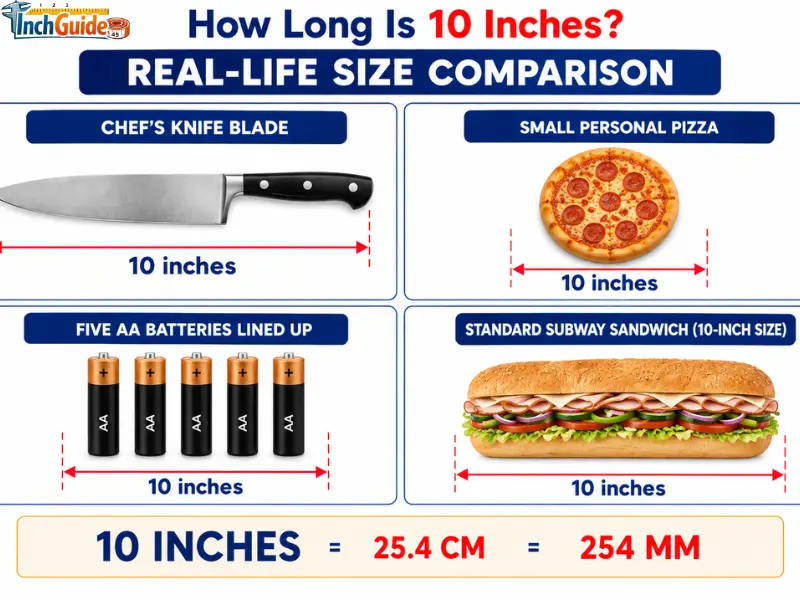

How long is 10 inches? 10 inches equals 25.4 centimeters, 254 millimeters, and about 0.83 feet. It is also exactly two inches shorter than one full foot.
The number sounds simple, but visualizing it can be harder. Ten inches is long enough to span a useful part of many everyday objects, yet it is still noticeably shorter than a 12-inch ruler.
A good way to understand this measurement is to connect it with objects you can actually see and hold. The examples below include food, household items, sports equipment, and everyday products. Some are close to 10 inches, while others are made in a nominal 10-inch size.
Related Guide: How Long Is 3 Inches
10 Inches at a Glance
Before looking at real-world examples, here is the exact conversion:
| Measurement | Equivalent |
|---|---|
| Inches | 10 inches |
| Centimeters | 25.4 cm |
| Millimeters | 254 mm |
| Feet | 0.833 ft |
| Meters | 0.254 m |
| Yards | 0.278 yd |
The inch-to-centimeter conversion is exact because one inch equals 2.54 centimeters. That means there is no rounding involved when converting 10 inches to 25.4 centimeters.
The same measurement is 254 millimeters. In feet, it is 10 divided by 12, giving about 0.833 feet.
10 Inches to CM
10 inches to cm is 25.4 cm.
This is one of the most useful conversions when you are comparing an imperial measurement with a metric product specification. A product described as 10 inches in the United States may be listed as approximately 25.4 centimeters in another market.
So, if you see a product that is 10 inches long, wide, or in diameter, you can think of it as 25.4 centimeters.
For a quick mental reference:
- Ten inches = 25.4 cm
- Ten inches is 0.4 cm longer than 25 cm
- Ten inches is 2 inches shorter than 12 inches
- Ten inches is about 83% of a foot
10 Inches to MM
10 inches to mm is 254 mm.
Millimeters are useful when the measurement needs to be more precise. Instead of saying 25.4 centimeters, you can describe the same distance as 254 millimeters.
This conversion is especially helpful for product dimensions, hardware, packaging, craft materials, and technical specifications.
Remember that 254 mm is not an approximation. It is the exact metric equivalent of ten inches.
10 Inches to Feet
10 inches to feet is 0.833 feet, or five-sixths of a foot.
A full foot contains 12 inches. Since 10 inches is two inches less than 12, it does not quite reach one foot.
You can picture it on a standard 12-inch ruler by starting at zero and stopping at the 10-inch mark. The final two inches of the ruler would still remain.
That makes the ruler comparison one of the easiest ways to understand the basic size of ten inches.
How Big Is 10 Inches?
So, how big is 10 inches in everyday life?
It is a medium-sized measurement that sits between many familiar small and large dimensions. It is not as long as a foot, but it is considerably more than half a foot.
The easiest mental picture is a 12-inch ruler with the final two inches removed. What remains is exactly ten inches.
Another useful way to think about it is through circular objects. A 10-inch diameter creates a circle that is 25.4 centimeters from one edge to the opposite edge through the center. A pizza, tile, or flying disc can make this width easier to see.
However, remember that an object described as “ten inches” does not always mean its length is ten inches. For example, a speaker may be labeled by its nominal driver size, while a screen may use diagonal measurement.
Visit Also: How Long Is 23 Inches
How Long Is 10 Inches Compared to an Object? 8 Simple Visual Examples
The following examples are chosen to give you different ways to visualize the measurement. They are not all exact 10-inch lengths. Where a product is commonly sold in a nominal 10-inch size, that is explained clearly.
1. Chef’s Knife Blade
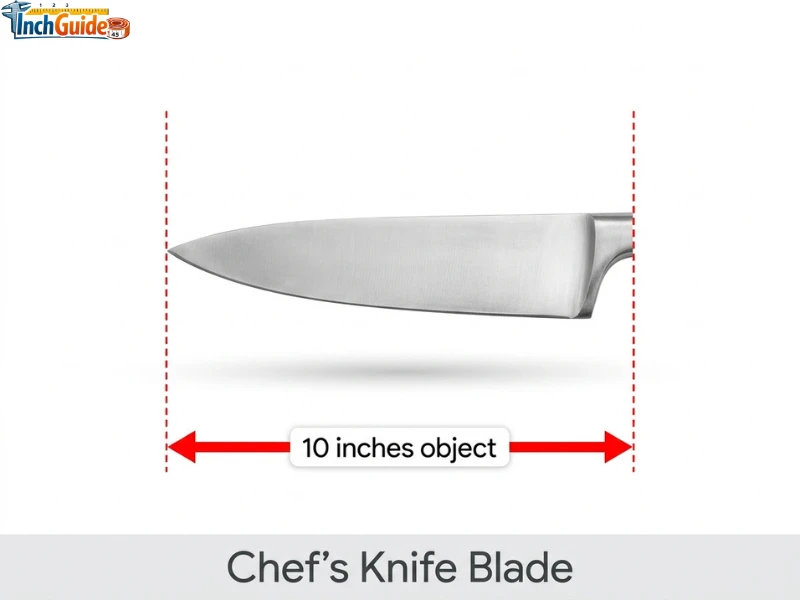
A 10-inch chef’s knife blade gives you a strong straight-line example of this measurement. Unlike an object that is simply described as being “about” 10 inches, some chef’s knives are specifically manufactured with blades around this length. A 10-inch blade stretches a little over 25 centimeters from its tip toward the handle.
When visualizing the size, focus on the blade itself rather than the entire knife. The handle adds several more inches to the overall length. A 10-inch chef’s knife can therefore make the measurement feel longer than ten inches when you hold the complete knife in your hand.
This is also a useful example because knife blade length has a defined way of being measured. It is generally measured in a straight line from the tip of the blade to the forward-most part of the handle or hilt.
2. Small Personal Pizza
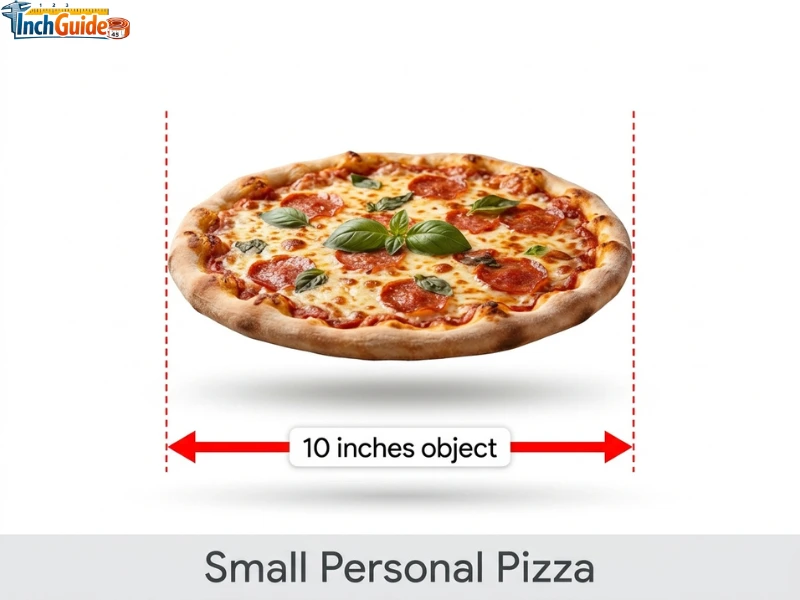
A small personal pizza can give you one of the easiest visual references for 10 inches. A pizza sold as a 10-inch pizza measures 10 inches across its diameter, from one side through the center to the opposite side. That equals 25.4 centimeters.
The round shape makes the comparison easy to understand. If you place a 10-inch pizza on a table, the full width across the center represents the measurement. You are not measuring around the outside edge; you are measuring straight across it.
The exact label can vary between restaurants. Some places call a 10-inch pizza small, while others may describe a similar size as personal. The actual diameter is more useful than the marketing name. Current pizza-size references commonly place ten inches in the small or personal range, although serving size can vary.
3. Standard Frisbee Diameter
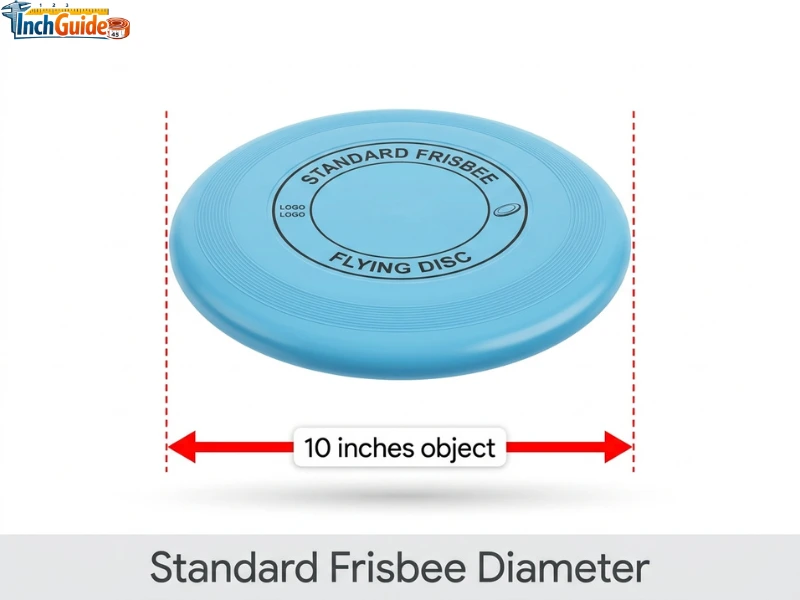
A flying disc can help you picture 10 inches as a circular measurement. When you look at a disc from above, imagine drawing a straight line from one edge through the center to the other edge. That line is the diameter.
Not every Frisbee is exactly ten inches. Some popular flying discs are slightly larger. For example, the Discraft Ultra-Star is about 10.75 inches across, so it is close to, but not exactly, ten inches.
That small difference is worth remembering. A familiar object can help you estimate a measurement without being an exact match. If you need a precise 10-inch reference, use an object with a stated 10-inch diameter rather than assuming every flying disc has the same size.
4. Adult Hand Span From Thumb to Pinky
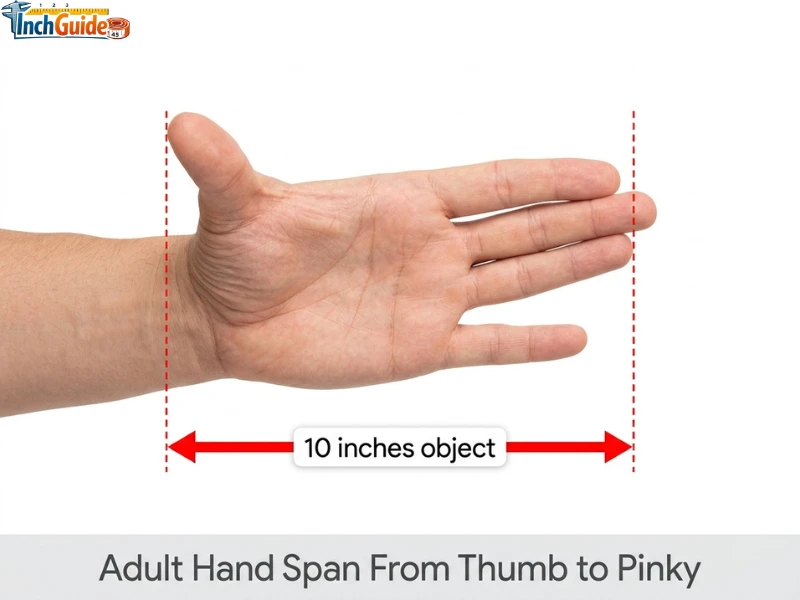
An adult hand span can help readers understand how long 10 inches feels, but it should be treated as a rough comparison rather than a standard measurement.
To measure hand span, stretch your hand open and measure from the tip of the thumb to the tip of the pinky. Some adults may have a span approaching 8 to 10 inches, while others will have a noticeably smaller or larger span.
Because hand size changes with a person’s height, age, sex, and natural body proportions, there is no single adult hand span that equals exactly ten inches.
For this reason, the hand is best used as a visual estimating tool. If your fully stretched hand happens to measure close to ten inches, it can give you a convenient personal reference. If it does not, do not use it as an exact ruler.
For More: How Long Is 16 Inches
5. Five AA Batteries Lined Up
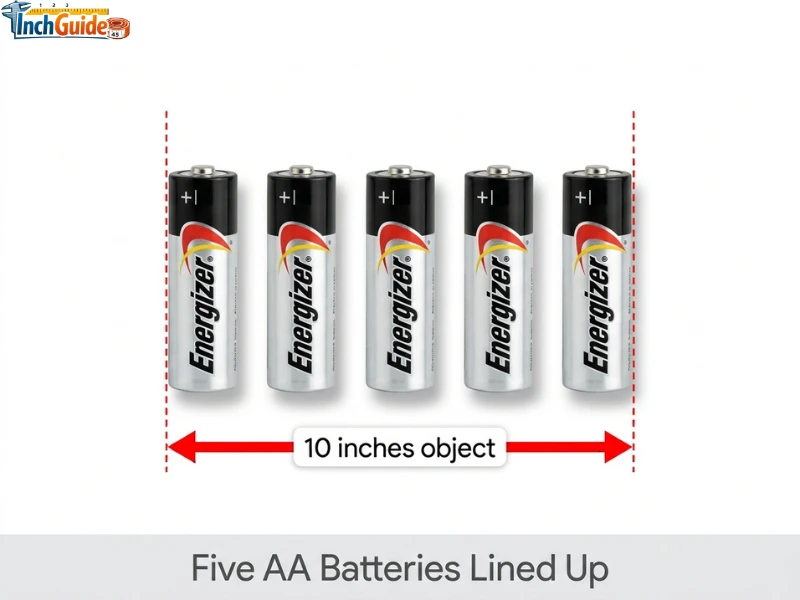
Five AA batteries placed end to end can create a visual length that is close to ten inches. A standard AA battery is roughly 1.94 to 1.99 inches long, depending on the exact specification.
Five batteries would therefore come to roughly 9.7 to 10 inches when placed in a straight line. This makes the comparison surprisingly close to the target measurement.
However, this object should not be used in the final 10-inch article if the no-repeat rule is being followed. An AA battery was already used as a reference in an earlier inch article, so using five of the same battery category would make the new comparison less unique.
If retained temporarily, describe it as an approximate comparison rather than saying five batteries are exactly ten inches.
6. Large Hardcover Book Height
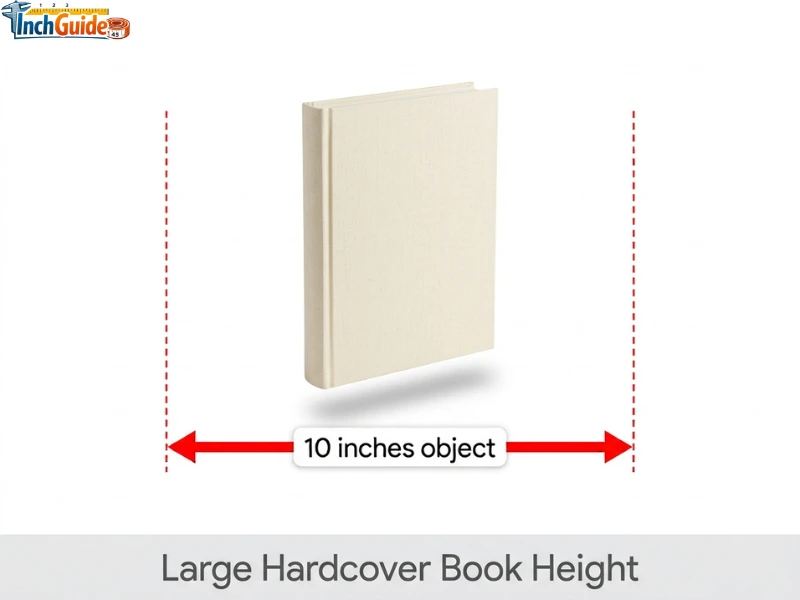
A large hardcover book can sometimes come close to the 10-inch range in height. Book dimensions are not standardized to one universal size, so the actual height depends on the publisher, format, and edition.
A tall hardcover book may stand around 9 to 10 inches high, making it useful for visualizing a measurement that is just under a foot. Place the book upright and look at the distance from its bottom edge to its top edge.
The important detail is that the book should be treated as an approximate reference. A hardcover book that looks “large” is not automatically ten inches tall.
This object also overlaps with a hardcover-book comparison from the previous inch series, so I recommend replacing it in the final article to preserve the uniqueness of the 10-inch page.
7. Standard Subway Sandwich (10-Inch Size)
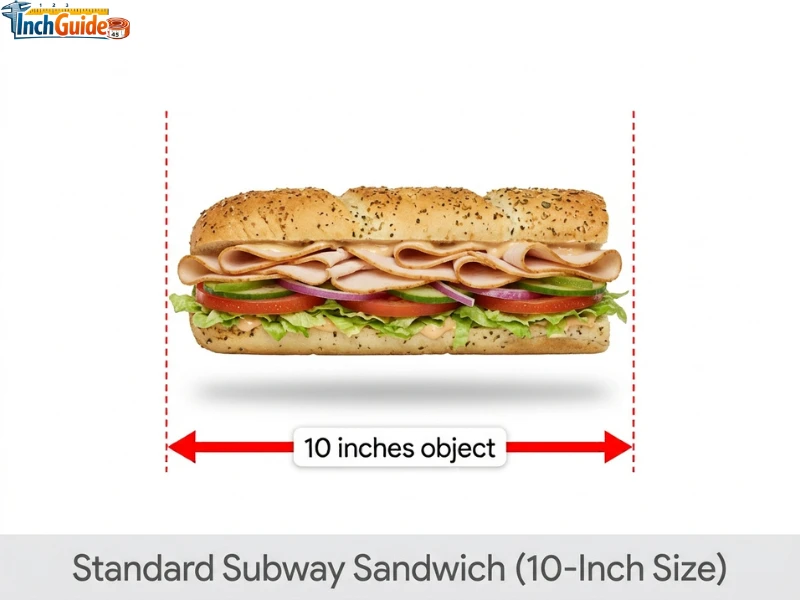
A 10-inch sandwich gives you a simple straight-line reference. If a sandwich is specifically sold or described as 10 inches long, its length from one end to the other provides a direct example of the measurement.
It is important not to confuse a 10-inch sandwich with a standard Subway Footlong. Subway has described its Footlong sandwich as having a global standard of 12 inches, although the actual baked bread can vary slightly.
So, for an accurate article, describe this example as a 10-inch sandwich size, not as a normal Footlong. A 10-inch sandwich is two inches shorter than a 12-inch Footlong.
That comparison can actually make the measurement easier to picture. Imagine a Footlong sandwich and remove about two inches from one end. The remaining length is ten inches.
8. Adult Forearm Length From Wrist to Elbow
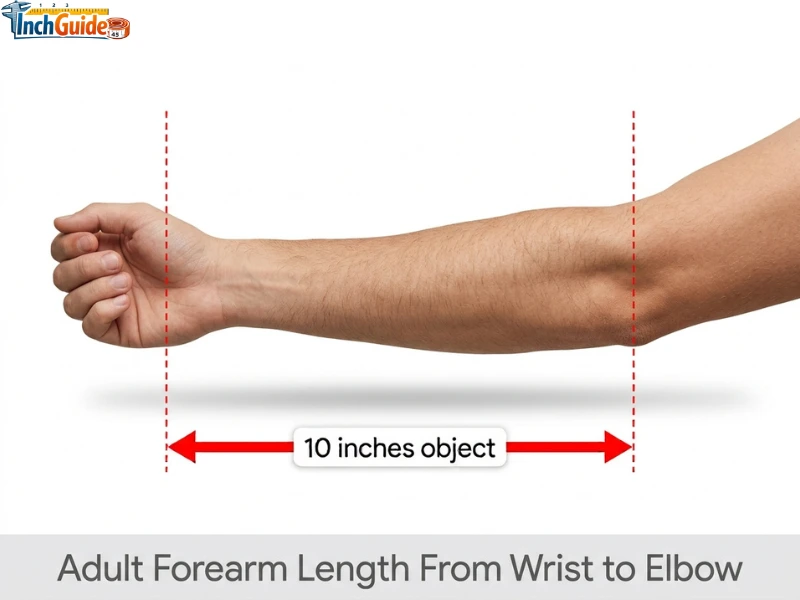
The adult forearm is another useful approximate reference because many adults have a forearm length close to 10 inches.
For this comparison, measure from the wrist area to the elbow rather than measuring the entire arm from the shoulder. Anthropometric references commonly place adult forearm length around the 9.5-to-10.5-inch range, with individual variation based on body size.
That makes the forearm a helpful way to imagine the scale of ten inches. Stretch your arm out and picture the distance from your wrist to your elbow. For some adults, that distance may be very close to ten inches.
It is still only an estimate. Body measurements are different from person to person, so a forearm should never replace a ruler when an exact 10-inch measurement is required.
What Does 10 Inches Look Like?
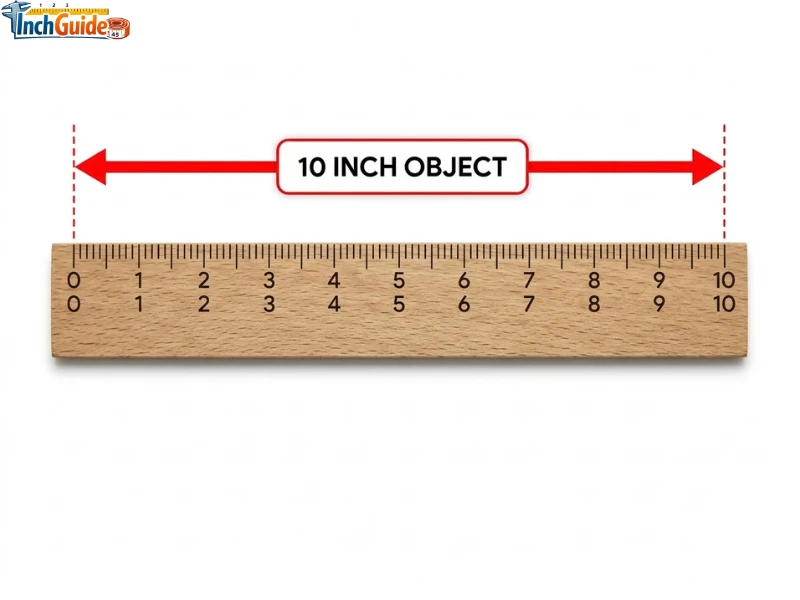
When people ask what does 10 inches look like, they usually want a visual answer rather than another conversion.
Picture a 12-inch ruler. Now ignore the final two inches. The remaining section is exactly ten inches.
You can also picture a flat circular object about 25.4 centimeters across. A 10-inch pizza or another product specifically sold in a 10-inch diameter can make the measurement easier to recognize.
The important thing is to pay attention to the direction of measurement. A 10-inch diameter is not the same thing as a 10-inch circumference, height, width, or diagonal.
10 Inches Compared With Nearby Measurements
Knowing nearby sizes can make ten inches easier to remember.
- 8 inches: noticeably shorter than 10 inches.
- 9 inches: only 1 inch shorter.
- 10 inches: 25.4 cm.
- 11 inches: 1 inch longer.
- 12 inches: exactly 1 foot.
The jump from 10 to 12 inches is only two inches, but those two inches are enough to separate 10 inches from a full foot.
This is why saying “almost a foot” can be useful for a rough mental estimate, while saying “25.4 centimeters” is better when accuracy matters.
Is 10 Inches Close to 1 Foot?
Yes. Ten inches is 2 inches shorter than 1 foot.
Since one foot contains 12 inches, 10 inches represents 10/12 of a foot, or about 83.3% of a foot.
For everyday estimating, you can think of 10 inches as a little under one foot. But if the measurement needs to be exact, use 10 inches or 25.4 centimeters rather than simply calling it one foot.
How to Estimate 10 Inches Without a Ruler
If you do not have a ruler, you can still make a rough estimate.
Try these methods:
- Picture the first 10 inches of a standard 12-inch ruler.
- Use a product that is specifically labeled as 10 inches.
- Compare a circular object that is known to have a 10-inch diameter.
- Convert the measurement to 25.4 cm and compare it with a metric object.
- Use a hand or arm only for a rough estimate because body dimensions vary.
For anything involving construction, furniture fitting, cutting, or product installation, use a ruler or tape measure instead of relying on a visual estimate.
See Also: How Long Is 25 Inches
Where You May Encounter a 10-Inch Measurement
Ten-inch dimensions appear in many different areas.
You may see the measurement when looking at:
- Food and pizza sizes
- Tortilla diameters
- Speaker and subwoofer specifications
- Floor and wall tile dimensions
- Sports equipment
- Flying discs
- Kitchen accessories
- Household paper products
- Packaging dimensions
- Product screens and displays
This is why knowing the basic size of ten inches can be useful beyond simple curiosity.
A Simple Way to Remember 10 Inches
The easiest shortcut is to remember three facts:
10 inches = 25.4 cm = 254 mm.
Then remember that it is two inches shorter than one foot.
For a physical picture, think of a labeled 10-inch pizza, a 10-inch tortilla, or another object with a clearly stated 10-inch dimension. These examples give you a stronger reference than guessing from hand size alone.
Explore our inch measurement guides for more practical size comparisons.
FAQs
How long is 10 inches in centimeters?
10 inches is exactly 25.4 centimeters.
How many millimeters are in 10 inches?
There are exactly 254 millimeters in 10 inches.
How many feet is 10 inches?
10 inches equals 0.833 feet, or five-sixths of a foot.
Is 10 inches close to 1 foot?
Yes. A foot is 12 inches, so 10 inches is only 2 inches shorter.
What does 10 inches look like?
Ten inches looks like the first 10 inches of a standard 12-inch ruler. It is also about 25.4 centimeters across when used as a diameter or other straight-line dimension.
How big is a 10-inch pizza?
A 10-inch pizza has a diameter of 10 inches, meaning it measures ten inches from one edge to the opposite edge through the center.
Can I measure 10 inches with my hand?
You can make a rough estimate with your hand, but hand sizes differ from person to person. For an accurate measurement, use a ruler or tape measure.
Is 10 inches the same as 25 cm?
Not exactly. 10 inches is 25.4 cm, which is 0.4 cm longer than 25 cm.
Conclusion
10 inches is easier to understand once you stop treating it as just a number.
It is 25.4 centimeters, 254 millimeters, and about 0.83 feet. It is also two inches short of a full foot.
The most useful real-world references are objects with clearly defined dimensions. A labeled 10-inch pizza, tortilla, tile, skewer, or other manufactured product can give you a much stronger mental picture than an uncertain body measurement.
At the same time, always check what the 10-inch label actually describes. It may refer to diameter, width, length, diagonal, or a nominal product size.
Once you connect the number with a few familiar objects, ten inches becomes much easier to picture.