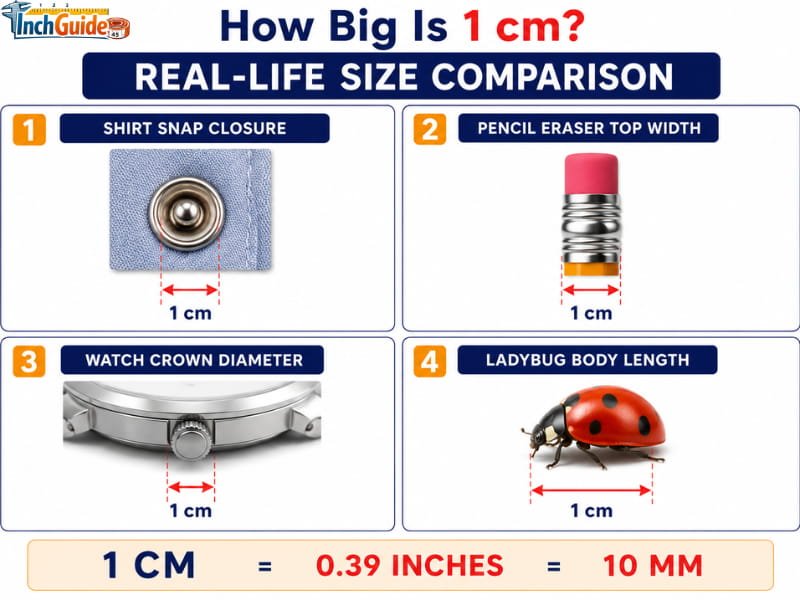

How big is 1 cm? 1 cm = 10 mm = 0.01 meters = 0.39 inches = 0.033 feet = 0.011 yards = 0.00001 kilometers = 10,000 micrometers = 10,000,000 nanometers.
QUICK ANSWER 1 cm = 0.39 inches = 10 mm = less than half an inch
One centimeter is exactly 0.39 inches — less than half an inch, and one of the most misunderstood sizes in American daily life. Most people hear “1 cm” and picture something bigger than it actually is. The reality? It is the width of the M&M in your pantry. The diameter of the blueberry in your fridge. The snap button on the denim jacket in your closet. All of them sit right at 1 cm — verified, standardized, and completely overlooked until now.
This tiny length shows up everywhere in American daily life — in medicine, crafts, cooking, and tech. Once you connect it to things you already own, you will picture it instantly every time.
1 Cm Conversion Table
| Unit | Value |
| Millimeters | 10 mm |
| Inches | 0.39 inches |
| Feet | 0.033 ft |
| Meters | 0.01 m |
| Yards | 0.011 yd |
How Big Is 1 CM Really And Why Does It Feel Smaller Than You Think?
One centimeter is small — noticeably smaller than half an inch. Most Americans, when they hear “one centimeter,” picture something bigger than it actually is. That is because inches dominate American daily life, and centimeters mainly show up at the doctor’s office or on imported packaging.
1 cm is the width of your pinky fingernail. Not the whole finger — just the nail. Hold your pinky up right now and look at it. That tiny strip of nail is almost exactly 1 cm wide for most American adults.
On a standard metric ruler, 1 cm is the distance between any two numbered marks. It looks almost impossibly small at first. But once you start seeing it in everyday objects — the blueberry in your fridge, the M&M in your pantry — it stops feeling abstract and starts feeling completely familiar.
No Ruler? No Problem Here Is How to Measure 1 CM Right Now
Use Your Pinky Fingernail
Look at your pinky finger right now. The width of the nail — from one side to the other — is approximately 0.9 to 1.1 cm for most American adults. Measure yours once with a ruler and you have a built-in reference for life.
Use a Standard Pencil Body
Pick up any No. 2 pencil from your desk. Its diameter across the round body is approximately 7 to 8 mm — just under this target size. For everyday estimates, a pencil body width gives you a near-perfect reference you can find anywhere.
Use a Single M&M Candy
Grab one M&M from a bag. A standard plain M&M measures approximately 1.0 to 1.2 cm in diameter. Every M&M is made to consistent sizing through automated manufacturing — making it one of the most fun and accurate references available.
You Are Already Using 1 CM Every Day — You Just Do Not Know It Yet
This tiny measurement shows up across more areas of American life than most people expect:
- Medical: Doctors describe tumors, wounds, and skin lesions in centimeters — this is the most frequently referenced small medical size.
- Crafts and sewing: Seam allowances, bead sizes, and button diameters are all measured in centimeters.
- Cooking: Small foods like blueberries, peas, and chocolate chips are measured in centimeters for recipes and portion guides.
- Tech: Screen border widths, SIM card dimensions, and cable connector widths reference this range.
- Hardware: Small screw heads, washer diameters, and nail heads commonly fall in this range.
- Beauty: Nail art, eyelash lengths, and eyebrow measurements are tracked in centimeters by professionals.
13 Everyday USA Objects That Are Exactly 1 CM All Verified
Every object below is USA-specific and verified. Pick any one and you have a solid reference right in your hand.
1. No. 2 Pencil Diameter
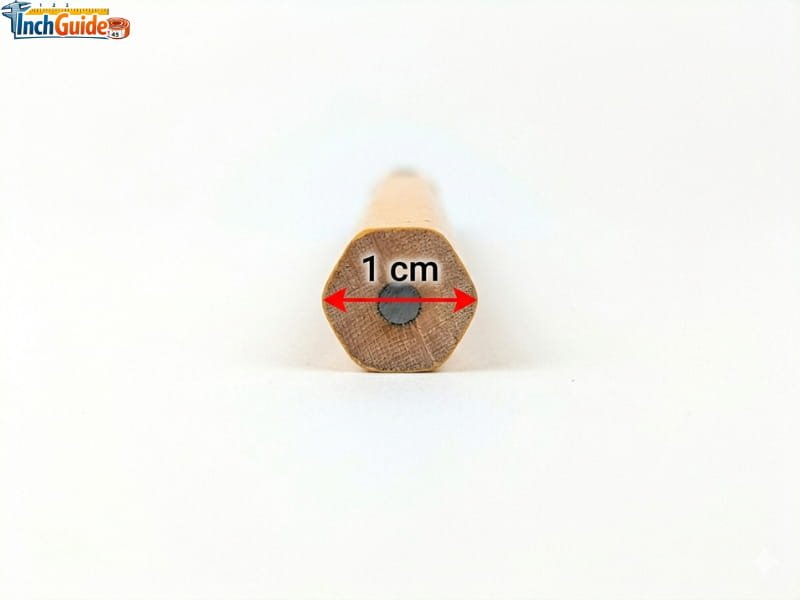
Pick up any pencil from your desk right now. Before you write a single word, look at the body — not the tip, not the eraser, just the round wooden shaft. That width is your first 1 cm reference.
A standard No. 2 pencil measures 7 to 8 mm in diameter across the body. Dixon Ticonderoga — the best-selling pencil brand in the USA, sold at every Walmart, Target, and Staples — holds this diameter consistent across their entire lineup through precision manufacturing.
Here is a surprising fact: this diameter was not chosen randomly. The 7-8mm standard evolved from the human hand’s natural pinch grip — wide enough to hold comfortably between two fingers without slipping, narrow enough to control precisely while writing.
See Also: How Big Is 1 CM
2. Cultivated Blueberry
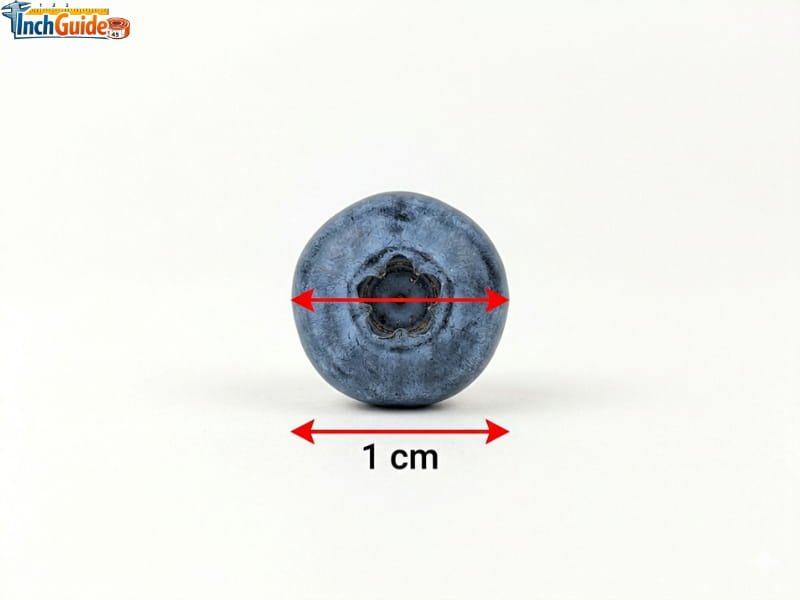
Pull one blueberry from your refrigerator right now and set it on the counter. Look at it from above. That round berry — so ordinary, so easy to grab without thinking — is one of the most naturally accurate 1 cm references in an American kitchen.
Wild blueberries are smaller — typically 0.5 to 0.8 cm. The berries you buy at a grocery store are the cultivated variety, which farmers have selectively grown larger over decades specifically to hit this size range for consumer appeal.
The blueberry in your fridge has always been 1 cm. It sat there through breakfast smoothies, morning yogurt, and weekend pancakes — quietly measuring itself, waiting for someone to notice.
3. Shirt Snap Closure
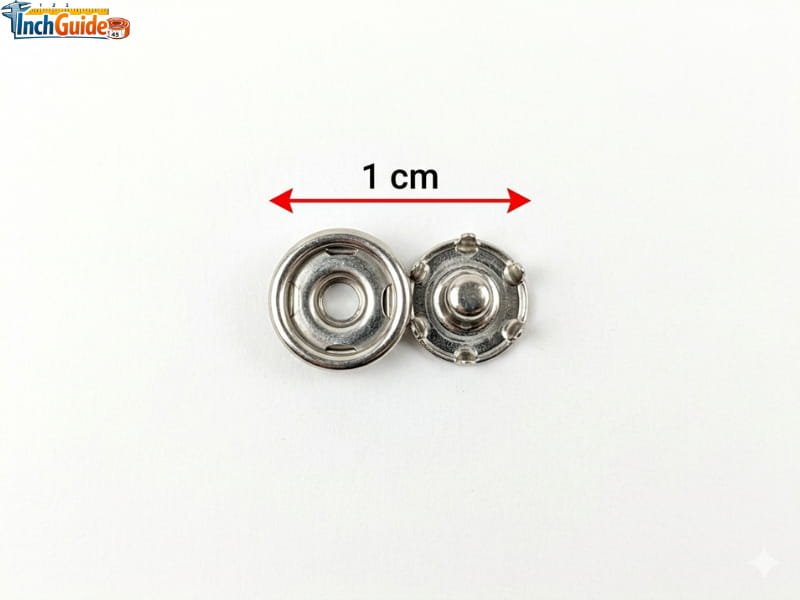
Open your closet and find anything with snap buttons — a denim jacket, a flannel shirt, a baby onesie, or a Western shirt. Press your thumbnail against one snap and look at the metal circle it makes. That circle is your 1 cm reference.
The 10mm standard exists because it is the smallest size that provides a secure closure without being difficult to fasten with adult fingers. Baby onesies use them because they are gentle enough for infant skin. Western shirts use them because they are faster than buttons. The same 1 cm snap serves both — unchanged for over a century.
4. Frozen Pea Diameter
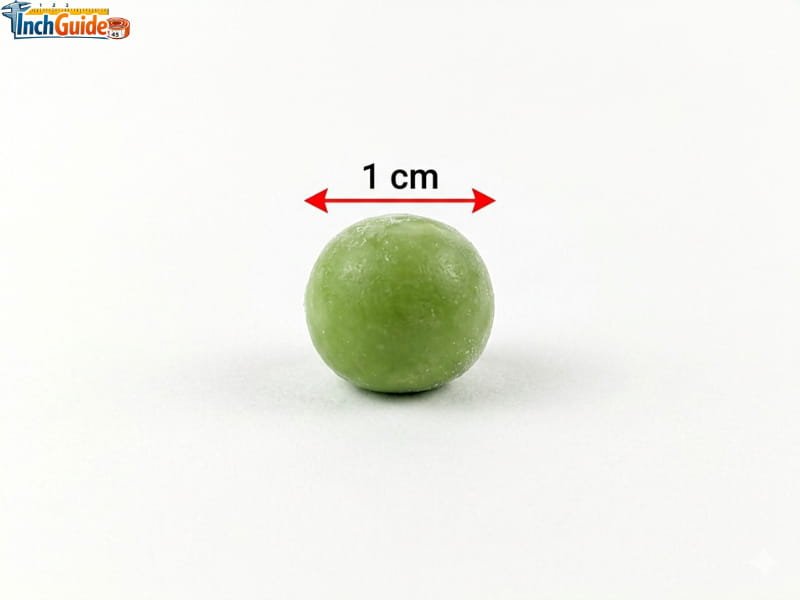
Open your freezer and look for peas — Birds Eye, Green Giant, or any store brand will do. Pull out a single frozen pea and set it on your palm. That small green sphere is one of the most precisely standardized food items in the American grocery system.
Most people are surprised to learn that peas are federally sized. But the USDA has been setting produce dimensions since 1946 — keeping American peas consistent across every grocery chain, every season, every year since.
The peas in your freezer are not just dinner. They are government-certified 1 cm references, officially measured before they ever reached your bag.
5. Corn Kernel Width
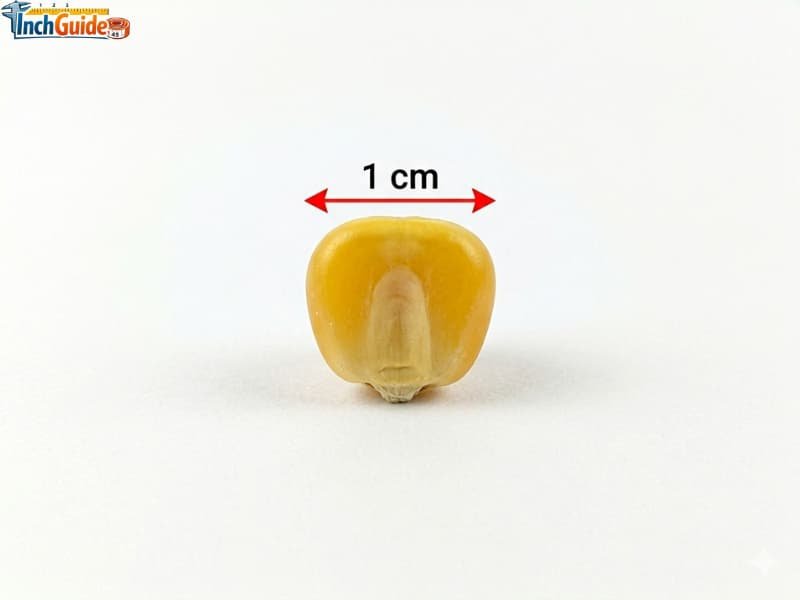
Look at your next ear of corn — whether fresh from the farmers market or out of a Birds Eye or Green Giant frozen bag. Pull one kernel off and set it on the counter. Width-wise, from one side to the other, that kernel is right at 1 cm.
Sweet corn is one of the most consumed vegetables in the USA. Americans eat an estimated 25 billion ears of corn annually according to USDA agricultural data. Every kernel on every one of those ears has been sitting at approximately 1 cm wide — on Thanksgiving tables, at summer barbecues, and at every backyard cookout across all 50 states.
See Also: How Big Is 3 CM
6. Plain M&M Candy
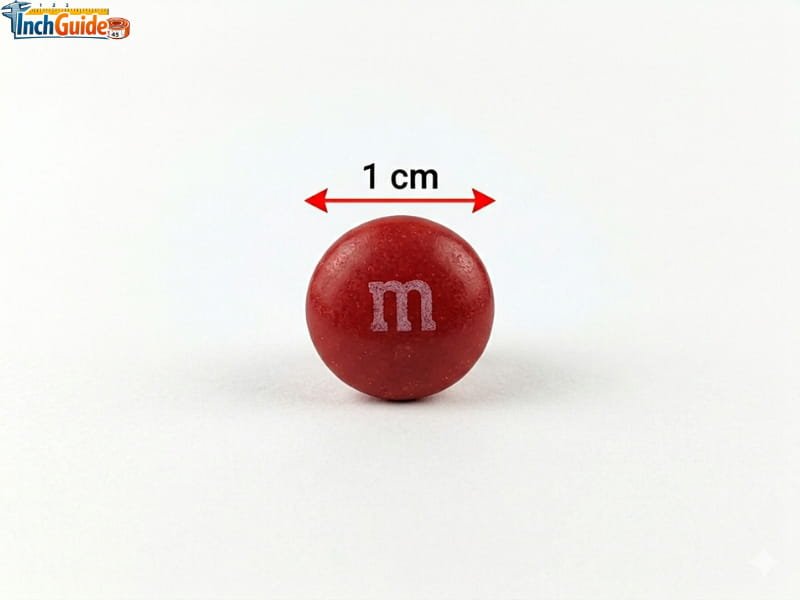
Reach into any M&M bag and pull out one candy. Set it on a flat surface and look at it from above. That round, colorful disc is one of the most consistent, most available, and most eaten 1 cm references in America.
Here is a fact that surprises most people: Mars produces approximately 400 million M&Ms every single day in the United States. Each one is individually checked by automated optical scanners during quality control to ensure size consistency.
The candy that seems so casual and disposable is actually one of the most precisely manufactured 1 cm objects in American daily life. Eat it when you are done. You have confirmed the measurement.
7. Pencil Eraser Top Width
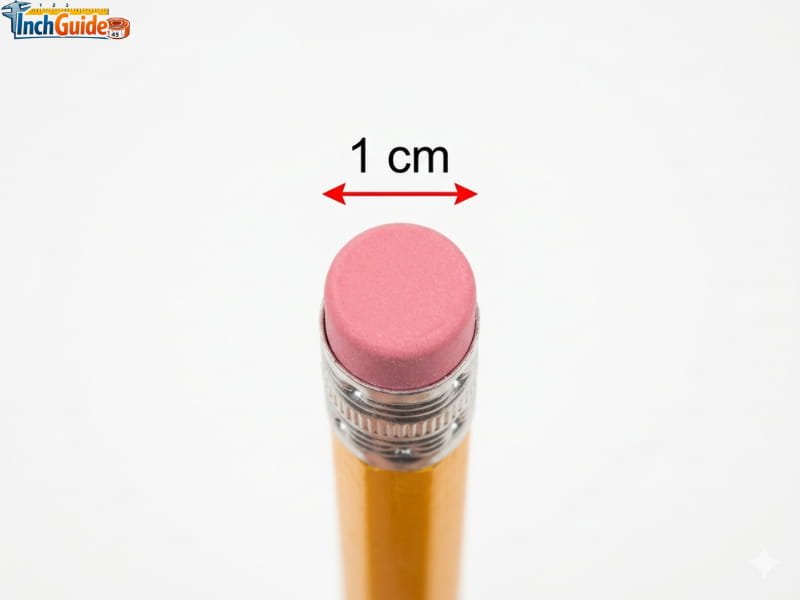
Flip any No. 2 pencil upside down and look at the pink eraser on top. The rubber eraser itself — not the metal ferrule, just the pink part — measures approximately 8 mm wide. Either way, you are right in the 1 cm range.
What most people do not know: the pink eraser color is not accidental. Dixon chose pink because the pumice compound mixed into the rubber — which is what actually removes graphite — turns the rubber a natural pinkish-tan during manufacturing. The color was a byproduct of the formula, not a design decision. It stuck because everyone came to associate pink with erasing.
The eraser on your desk pencil has been quietly measuring 1 cm at its tip for however long you have owned it.
8. Tic Tac Mint Length
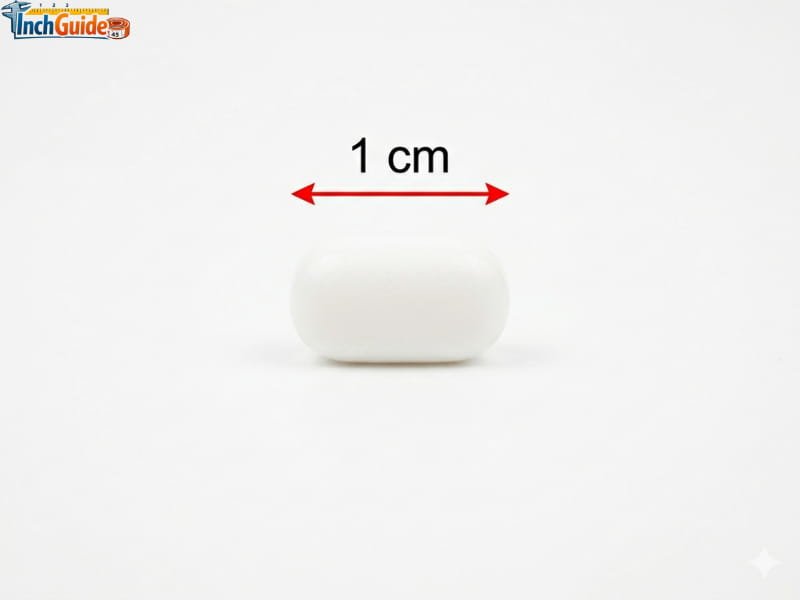
Pick up a single Tic Tac — the original orange box flavor sold at every grocery store checkout lane, gas station counter, and pharmacy in the USA. Stand it upright on your fingertip and look at its length. That tiny pillow-shaped mint is exactly 1 cm from end to end.
A standard Tic Tac mint measures approximately 1.0 to 1.1 cm in length. Ferrero — the candy company that manufactures Tic Tac for the US market — maintains this size through automated candy-forming equipment. The size was chosen to be exactly one serving per mint, small enough to dissolve quickly, large enough to deliver a noticeable flavor burst.
9. Watch Crown Diameter
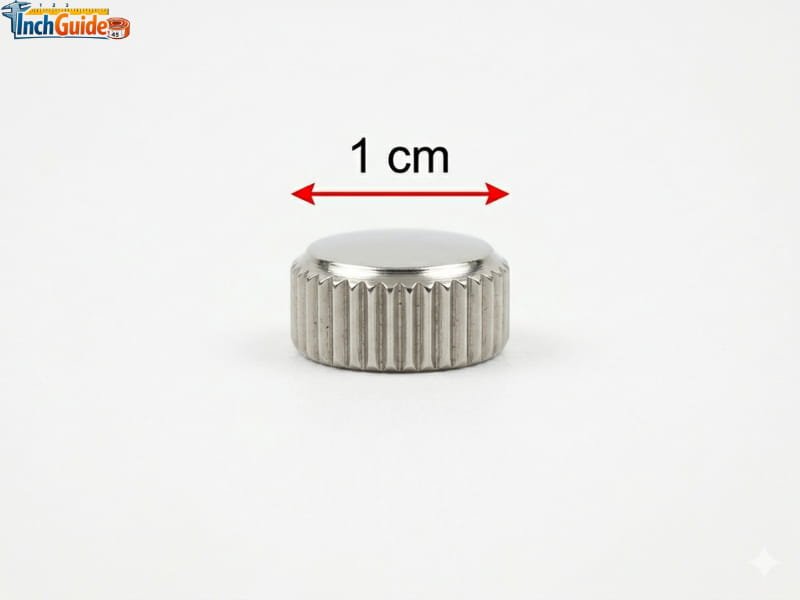
Find any wristwatch — dress watch, sport watch, or any watch with a physical crown on the side — and look at the small knob used to set the time. That knob is your wrist-worn 1 cm reference.
Seiko has been manufacturing watches since 1881. Casio since 1957. Timex since 1854. Across all three companies and all those decades, the watch crown has stayed at approximately this size — because the human finger has not changed either.
The watch on your wrist carries a verified 1 cm reference on its side. You pass it through every doorway, every handshake, every meeting. It was always there.
10. Freshly Sharpened Pencil Tip
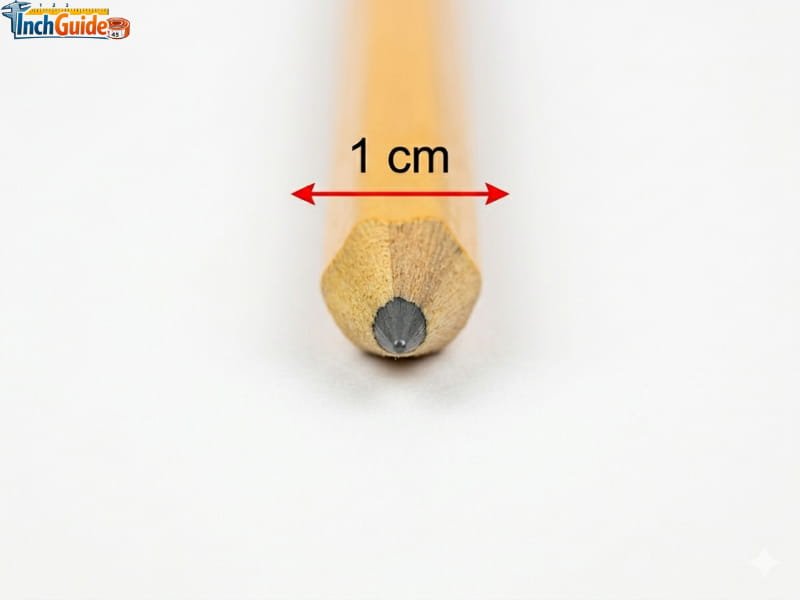
Sharpen any No. 2 pencil to a standard point. The exposed graphite tip — from where the wooden cone ends to the very tip point — measures approximately 0.8 to 1.2 cm in length on a freshly sharpened Dixon Ticonderoga.
Every student in America sharpens pencils constantly. That freshly sharpened tip you write with is a perfect tiny reference at the end of every pencil in your cup.
See Also: How Big Is 12 CM
11. Ladybug Body Length
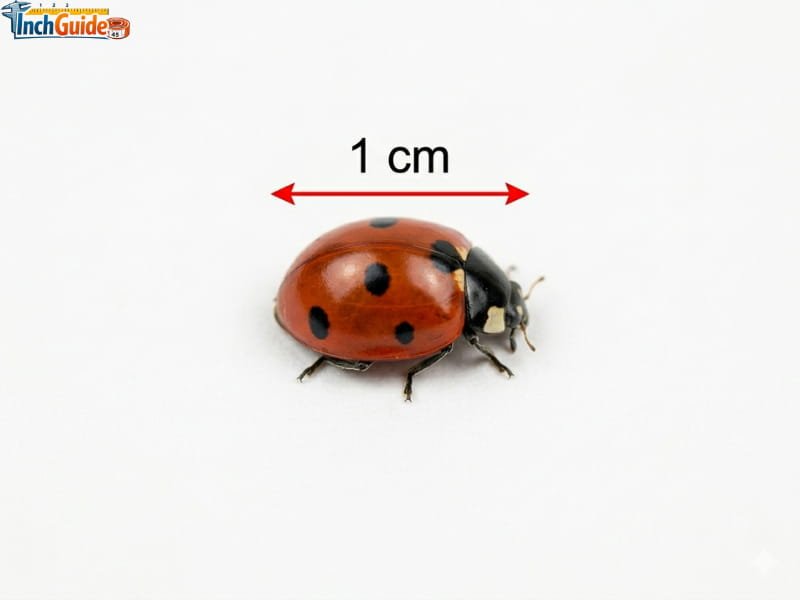
Think about the last ladybug you saw on a window or garden plant. A standard North American ladybug — specifically the Asian Lady Beetle most common across the USA — measures approximately 7 to 10 mm in body length. This species was introduced across the USA by the USDA in the 1970s for pest control.
Most Americans have seen one recently. That little red beetle with black spots is one of nature’s most recognizable references for this tiny size — living proof that it is all around you even outdoors.
12. Standard 10mm Craft Bead
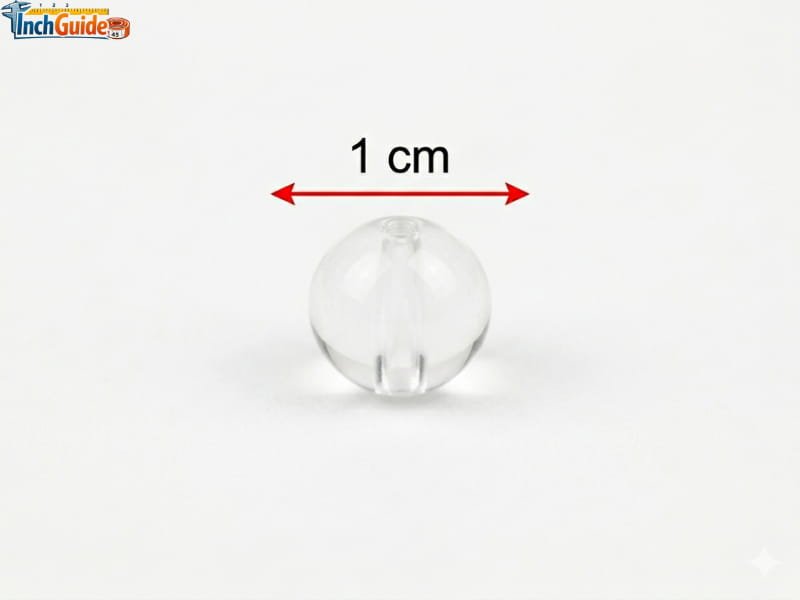
Open any jewelry kit, craft supply drawer, or beading bag in your home. Find a round bead that feels like a medium size — not the tiny seed beads, not the large statement beads. That medium round bead is almost certainly a 10mm bead, and it is exactly 1 cm.
The 10mm bead is the most precisely manufactured everyday object on this entire list. Unlike food items that vary with ripeness or biology, a bead is machined or molded to exact tolerances. When JOANN labels a bead as 10mm, it is 10mm — confirmed, measured, and guaranteed.
13. Chocolate Chip Width
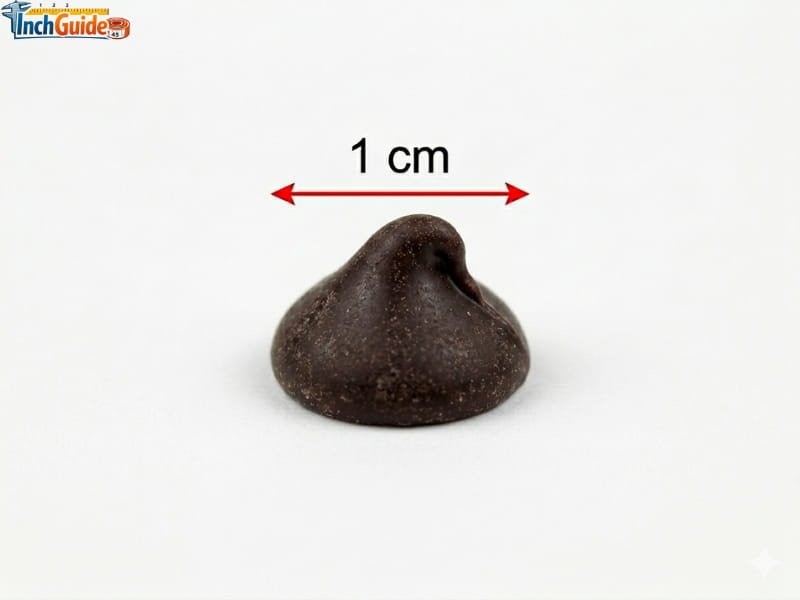
Pull the bag of chocolate chips from your pantry — Toll House, Ghirardelli, or any store brand. A standard semi-sweet chocolate chip measures approximately 0.9 to 1.1 cm at its base. Nestle Toll House — the best-selling chocolate chip brand in the USA — manufactures chips to consistent sizing through automated equipment.
Most American kitchens have chocolate chips somewhere. Every time you bake cookies, look at one before it melts. That little chip in your hand is right at this size.
Here Is Exactly Where 1 CM Falls on a Standard Ruler
Pick up any ruler with metric markings on it. On the metric side, the numbered marks are exactly 1 cm apart — from 0 to 1, from 3 to 4, from 7 to 8. That space between any two numbered marks is exactly the size we are talking about.
Between those marks, smaller lines divide each centimeter into 10 equal millimeter sections. This length on a ruler is noticeably shorter than half an inch. You can cover it completely with your fingertip.
On the imperial side of the same ruler, 1 cm falls at the 0.39-inch mark — just under the first half-inch graduation. Once you find it once, you will never forget where it sits.
1 CM vs 1 Inch — The Difference Most Americans Get Wrong
Most Americans instinctively think of inches first. When someone says “one centimeter,” the brain reaches for the nearest familiar unit — and it usually overshoots. The result: most people picture 1 cm as bigger than it really is.
Here is the correction. One inch is 2.54 cm — so 1 cm is less than 40% of an inch. Put it another way: you could fit two and a half centimeters inside one inch with room left over. On a ruler, 1 cm looks noticeably shorter than half an inch. That gap surprises most people the first time they see it side by side.
The confusion runs both directions. Americans shopping on international websites often see dimensions in centimeters and mentally convert them incorrectly — ordering items that arrive either larger or smaller than expected. A phone case listed as “1 cm thick” is not “almost half an inch thick.” It is thinner than that. Knowing this saves real money on returns.
Why This Tiny Measurement Shows Up in the Biggest Moments of Your Day
When your doctor says a mole is “1 cm in diameter” — that is a blueberry. When a sewing pattern calls for a “1 cm seam allowance” — that is a pencil-body width from the edge.
Knowing this size by feel removes the guesswork from medical conversations, craft projects, cooking decisions, and online shopping every day. You stop second-guessing and start knowing — and the objects that prove it are already in your home right now.
If you enjoyed reading this article, you might also like the ones below.
- How Big Is 3 CM? Real-Life Size Guide With 13 Common Objects
- How Big Is 4 CM? 13 Real-Life Objects That Are About 4 CM
- How Big Is 5 CM? 13 Common Objects That Are About 5 CM
- How Big Is 6 CM? 13 Common Objects That Are About 6 CM
- How Big Is 7 CM? 13 Real-Life Objects That Are About 7 CM
- How Big Is 8 CM? 13 Real-Life Objects That Are About 8 CM
FAQs
What is 1 cm in inches?
One centimeter equals exactly 0.39 inches. Multiply any centimeter number by 0.394 to convert to inches. This conversion is fixed and never changes.
What everyday object is exactly 1 cm?
A standard 10mm craft bead is exactly this size in diameter — the most precisely manufactured everyday reference at this measurement. A Tic Tac candy, blueberry, and M&M all measure approximately the same.
How big is this compared to a finger?
It is approximately the width of your pinky fingernail — much smaller than your thumb width (about 2.5 cm) and noticeably smaller than a dime’s diameter (1.79 cm).
How do you visualize this without a ruler?
Three fastest ways: your pinky fingernail width, a single blueberry from your fridge, or one M&M from your pantry. Pick whichever is nearest to you right now.
Is 1 cm the same as 10 mm?
Yes — exactly. There are always 10 millimeters in one centimeter. This is a fixed metric relationship that never changes.
Is 1 cm bigger or smaller than 1 inch?
Much smaller. One inch equals 2.54 cm — so an inch is two and a half times larger. This is one of the most common measurement confusions Americans face.
How many centimeters in an inch?
There are exactly 2.54 centimeters in one inch. So this size is approximately 40% of one inch.
What does this look like compared to a dime?
A US dime has a diameter of 1.79 cm — almost double this size. So one centimeter is noticeably smaller than a dime when placed side by side.
Is a blueberry exactly this size?
Very close. A standard cultivated blueberry measures 0.8 to 1.2 cm depending on ripeness. For everyday estimates, a blueberry is a reliable reference.
How many millimeters is 1 cm?
Exactly 10 millimeters. There are always 10 mm in every centimeter — the most useful conversion in the metric system.
Is this measurement used in the USA?
Yes — more than most Americans realize. Doctors use it for medical measurements. Crafters use it for bead and button sizing. Cooks use it for food portion guides. It shows up constantly even though the US primarily uses inches.
What is the easiest way to remember this size?
Think of a single M&M. Every plain candy is approximately this wide — a fun, tasty reference that most Americans have eaten hundreds of times. Once you connect this size to an M&M, you will never forget it.
See Also: How Big Is 2 CM? 13 Common Things That Are About 2 CM
Conclusion
1 cm = 0.39 inches = 10 mm = one hundredth of a meter.
Now you know exactly this size — and you have 13 real objects to prove it. The blueberry in your fridge. The M&M in your pantry. The pencil on your desk. The peas in your freezer. The chocolate chips in your cabinet. These are all around you right now.
Once your brain connects this tiny length to things you already touch every day, it becomes effortless. You will never wonder about this measurement again.