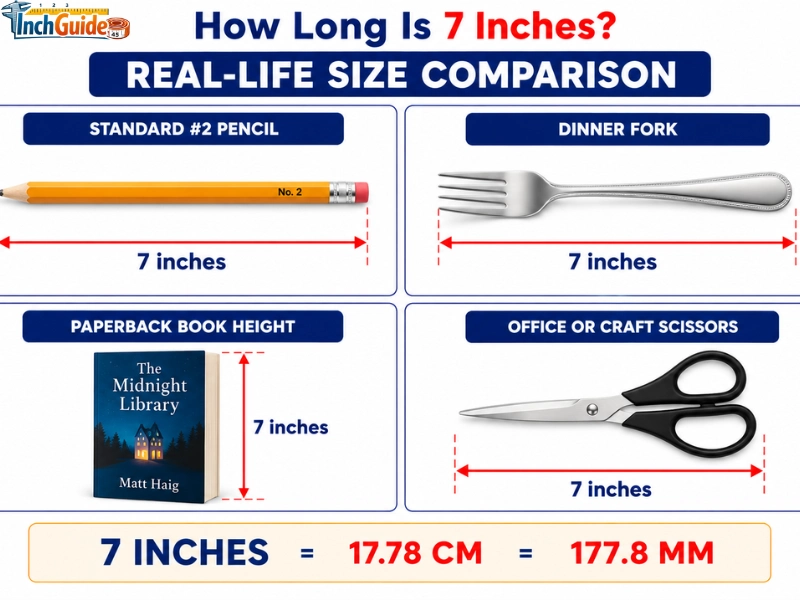

If you are wondering how long is 7 inches, the exact answer is 17.78 centimeters. It is also 177.8 millimeters and about 0.58 feet. In simple terms, seven inches is a little more than half a foot.
The number itself is easy to calculate, but picturing the actual length can be harder. You may know that a foot is 12 inches, yet seven inches does not have the same instantly familiar reference as one foot.
That is where everyday objects help. A pencil, dinner fork, paperback book, or hairbrush can give your eyes something familiar to compare with. Some of the objects below come very close to seven inches, while others have a seven-inch dimension in a particular direction.
One important point is that everyday products are not always made to one exact size. A pencil may be longer when new, a plate can vary by brand, and a sausage can differ greatly depending on its type. So the comparisons below are meant to help you visualize 7 inches, not replace a ruler when precision matters.
Related Guide: How Long Is 4 Inches
The Basic Size of 7 Inches
Seven inches is a little more than half the length of a standard 12-inch ruler. Half of 12 inches is 6 inches, so adding one more inch brings you to 7 inches.
In metric units, the same measurement is 17.78 cm. On a metric ruler, that puts seven inches between the 17 cm and 18 cm marks, much closer to 18 cm.
This makes 7 inches a useful middle-sized measurement. It is longer than many small handheld items, but still short enough to fit comfortably in one hand.
7 Inches Measurement Reference
| Unit | Equivalent |
|---|---|
| Inches | 7 inches |
| Centimeters | 17.78 cm |
| Millimeters | 177.8 mm |
| Feet | 0.5833 ft |
| Meters | 0.1778 m |
| Yards | 0.1944 yd |
For a quick estimate, think of seven inches as roughly 18 centimeters. For exact conversion, use 17.78 cm.
For physical comparisons, remember that the objects in this guide do not all represent an exact seven-inch length. The 7-inch vinyl record is a fixed-format reference, while items such as pencils, forks, carrots, hairbrushes, and sausages can vary.to remember than the decimal conversion alone.
7 Inches to CM
To convert 7 inches into centimeters, multiply seven by 2.54 because one inch equals exactly 2.54 centimeters.
7 × 2.54 = 17.78 cm
Therefore, 7 inches to cm is 17.78 cm. For a quick everyday estimate, you can round that to about 18 cm, but the precise conversion remains 17.78 cm.
This difference matters when accuracy is important. An object that measures exactly 18 cm is 0.22 cm longer than seven inches.
On a metric ruler, you would find seven inches at the 17.78 cm position. That means it is only 2.2 millimeters away from the 18 cm mark.
7 Inches to MM
When you need the measurement in millimeters, seven inches equals 177.8 mm.
The calculation is simple because one inch contains 25.4 millimeters:
7 × 25.4 = 177.8 mm
So if a product specification says that something is 178 mm long, it is almost exactly seven inches. The difference is only 0.2 mm.
Millimeters are especially useful for smaller product specifications because they make small differences easier to describe. For example, 177.8 mm and 180 mm sound quite different as numbers, but physically they are separated by only 2.2 mm.
7 Inches to Feet
Seven inches is equal to 0.5833 feet.
This is because one foot contains 12 inches, so:
7 ÷ 12 = 0.5833 feet
For everyday thinking, there is an easier way to remember it. Six inches is exactly half a foot, and seven inches is one inch more than that.
So if you picture half of a foot and extend that distance by another inch, you have a good mental picture of seven inches.
How Big Is 7 Inches?
So, how big is 7 inches when you actually see it?
Imagine a straight line that is a little longer than half of a 12-inch ruler. It is also just under 18 centimeters. That gives you a better sense of scale than the decimal value alone.
Seven inches is large enough to be obvious when placed beside small stationery items, but it is still a compact length. This is why it appears in products such as books, grooming tools, kitchen items, craft supplies, and small electronics.
The best visual reference depends on what you already have around you. A new pencil, a dinner fork, a small paperback, or a hairbrush can all help, but their exact measurements can vary.
For an exact reference, however, a 7-inch vinyl record is much more dependable because the seven-inch format refers to its nominal diameter.
Visit Also: How Long Is 5 Inches
How Long Is 7 Inches Compared to an Object? 10 Everyday Examples
The following objects give you different ways to understand this measurement. Some are close to seven inches in overall length, while others have a particular seven-inch dimension.
1. Standard #2 Pencil
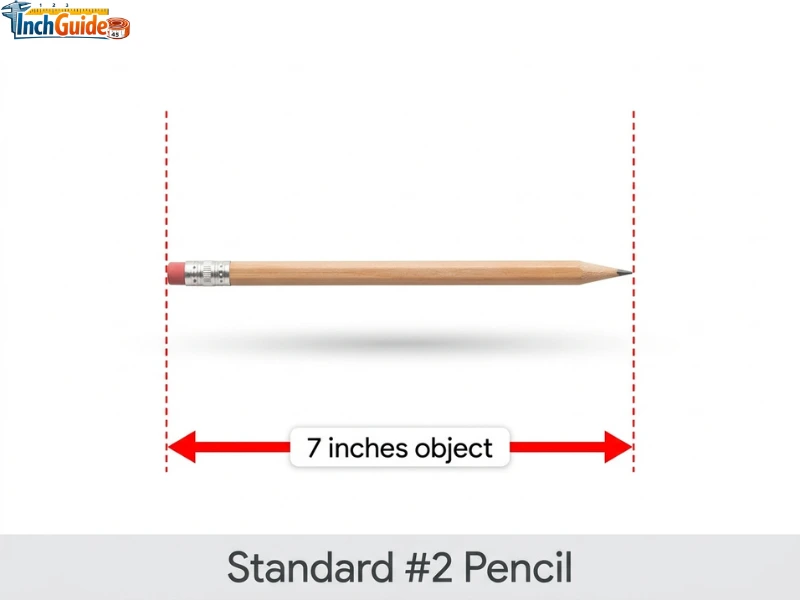
A standard new #2 wooden pencil is a familiar reference for seven inches, but there is an important detail: many full-length unsharpened pencils are closer to 7.5 inches than exactly seven inches. Current size comparisons commonly place a new unsharpened pencil around this range.
That means a brand-new pencil should not automatically be called an exact 7-inch object. It is better understood as a reference that is slightly longer than seven inches.
Once a pencil has been sharpened and used, its total length becomes shorter. A well-used pencil can therefore move closer to the seven-inch mark.
This makes the pencil particularly useful for visual comparison. If you hold a full-length pencil beside a ruler, you can see that seven inches reaches slightly short of the end of many new pencils.
2. Dinner Fork
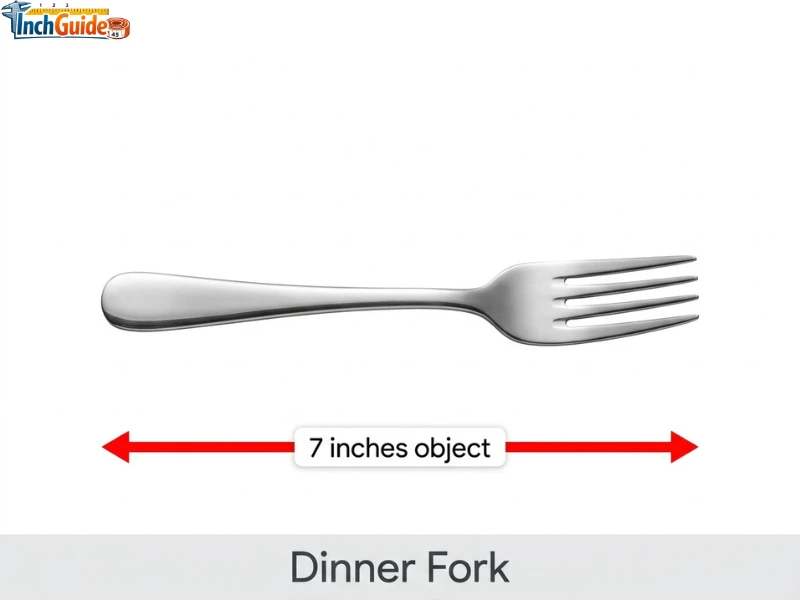
A dinner fork is another familiar way to picture this length. Many standard dinner forks measure around 7 to 7.5 inches from the tip of the tines to the end of the handle.
The important part is to measure the entire fork. Measuring only the metal head would give you a much shorter distance.
Dinner forks also make a useful comparison because they are found in many homes. You can place one flat on a table and imagine the seven-inch distance running from one end to the other.
Fork sizes are not identical, though. A salad fork is generally shorter, while some large serving forks are longer. So a normal dinner fork is best treated as an approximate seven-inch reference.
3. Large Carrot
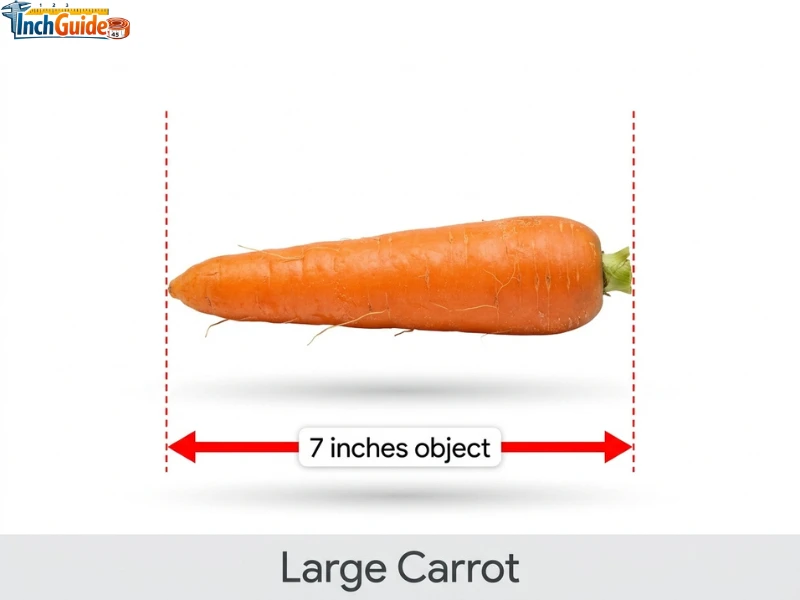
A large carrot can provide a surprisingly useful visual reference for seven inches. Some large carrots reach around this length, although natural produce varies considerably in size and shape. Seven-inch carrots are also commonly mentioned in everyday size comparisons.
Unlike a manufactured object, a carrot does not have a fixed standard length. One carrot might be five inches long, while another could be seven or eight inches.
The shape creates another small challenge. A carrot may taper from a thick top to a narrow tip, so its length is measured from end to end rather than by its width.
For example, if you see a large carrot that stretches almost the same distance as the 7-inch mark on a ruler, you have a good visual reference. But for accurate measurement, a ruler is still the better choice.
4. 7-Inch Vinyl Record (45 RPM)
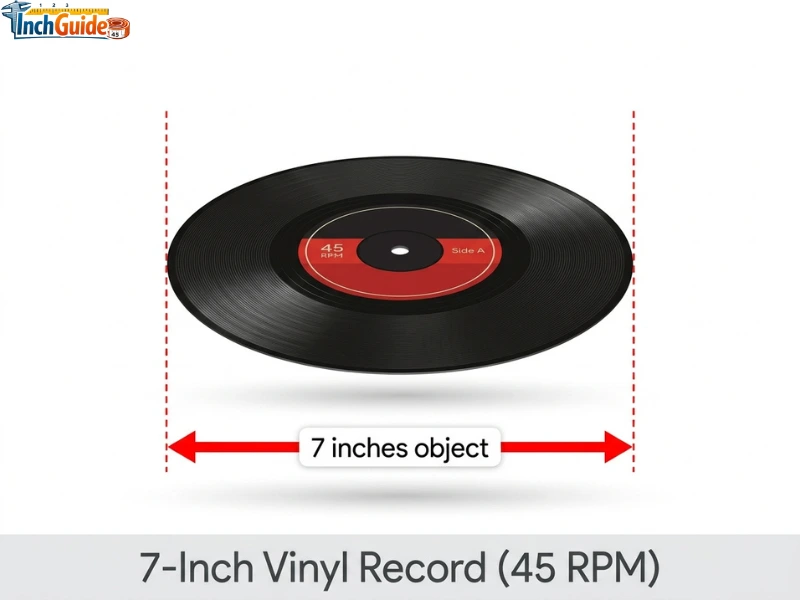
A 7-inch vinyl record is one of the strongest references in this list because the size is built into the name of the format.
A traditional 7-inch record has a nominal diameter of 7 inches. This means the distance from one edge of the circular record through its center to the opposite edge is seven inches.
That makes it different from an object that simply happens to be close to seven inches long. The circular diameter gives you a clearly defined seven-inch measurement.
If you have seen a 45 RPM single, picture the record lying flat on a table. Across its center, from one outer edge to the other, is the seven-inch reference.
For More: How Long Is 11 Inches
5. Paperback Book Height
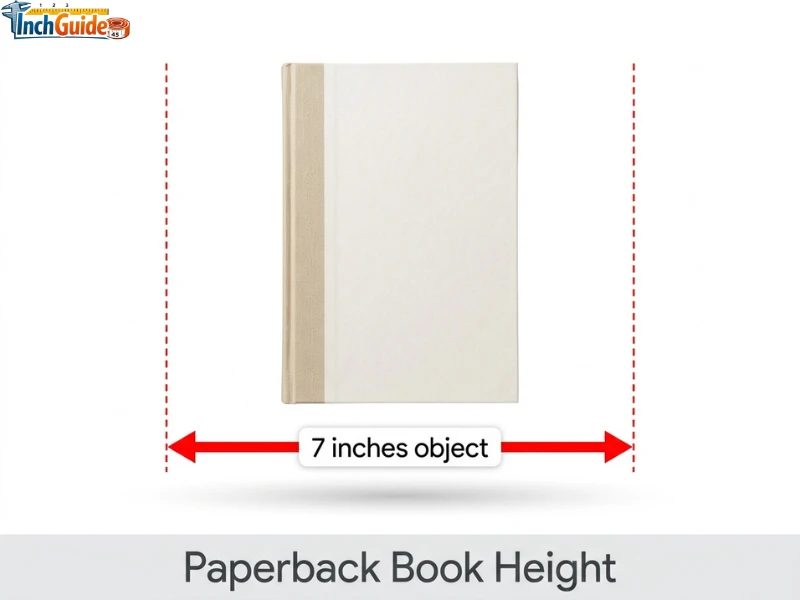
A small paperback book can often come close to seven inches in height. Many compact mass-market paperbacks fall in the neighborhood of 6.75 to 7 inches tall, although book formats vary by publisher and market.
This makes a paperback a useful comparison when someone asks what seven inches looks like in a bookshelf or on a desk.
Be careful about which dimension you are using. A book has height, width, and thickness, and only one of those dimensions may be close to seven inches.
For example, stand a compact paperback upright on a table. The distance from its bottom edge to its top edge may give you a good approximation of seven inches, while a larger trade paperback could be noticeably taller.
6. Hairbrush
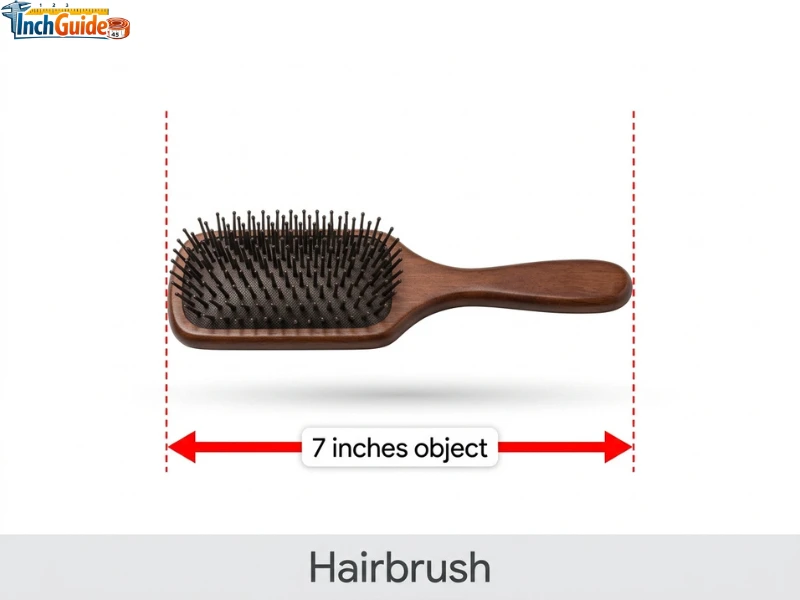
A hairbrush can also give you a practical idea of seven inches. Many compact or standard hairbrushes fall somewhere around the seven-inch range, although their exact dimensions depend on the brush design.
When using a hairbrush as a reference, measure the complete brush from the far end of the handle to the opposite end of the brush head.
The handle itself may be considerably shorter than seven inches. It is the overall length of the brush that provides the comparison.
For example, place the hairbrush flat on a countertop beside a ruler. If the full brush reaches close to the 7-inch mark, you now have a familiar household reference that you can remember for future estimates.
7. Office or Craft Scissors
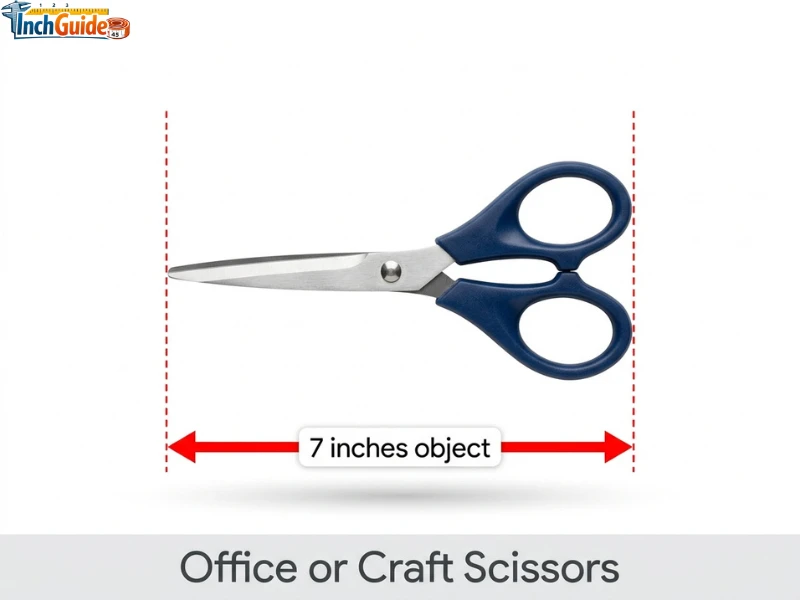
A pair of office or craft scissors can also fall near the seven-inch range when measured from the tip of one blade to the far end of the handles.
Scissors come in many sizes, so this is not an exact standard. Small children’s scissors may be much shorter, while large fabric shears can be significantly longer.
The measurement also refers to the complete closed scissors, not just the cutting blades. That distinction is important because blade length and total tool length can be very different.
For example, if a pair of craft scissors measures about seven inches when closed, placing it beside a ruler will show you a familiar straight-line reference. Current 7-inch comparison guides also commonly include closed scissors around this size.
8. Small Tablet or E-Reader
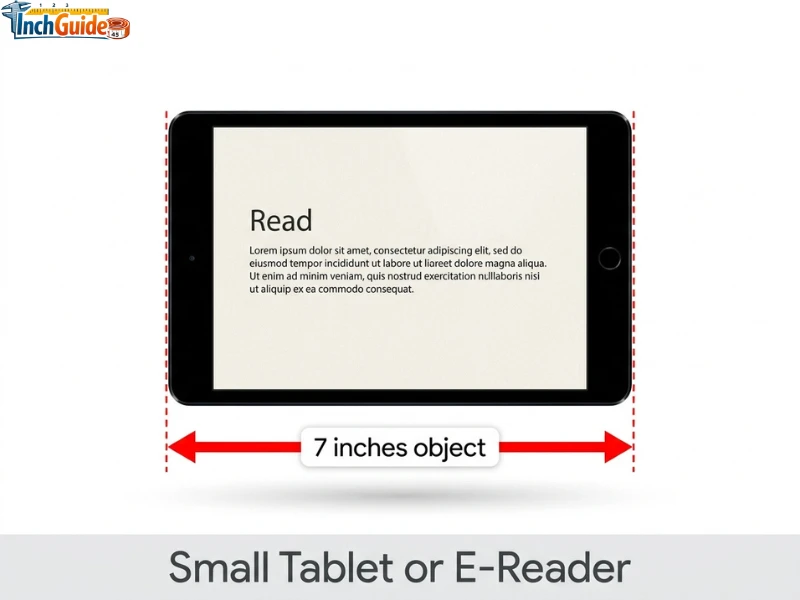
A small tablet or e-reader can help you visualize seven inches, but screen measurements need special attention.
When a device is described as having a 7-inch screen, the seven inches normally refers to the diagonal distance across the display, from one corner to the opposite corner. It does not mean the device is seven inches tall or seven inches wide. Current 7-inch measurement guides specifically note this distinction.
This makes a small tablet a useful example of how the same number can describe a different type of measurement.
Imagine drawing a line diagonally across a seven-inch display. That diagonal is seven inches, while the actual height and width of the device will both be smaller than seven inches.
So if you are trying to understand 7 inches using a tablet, look at the screen specification first. Do not assume that the outside body of the tablet measures seven inches from top to bottom.
9. Standard Dinner Plate Diameter (Small or Salad Size)
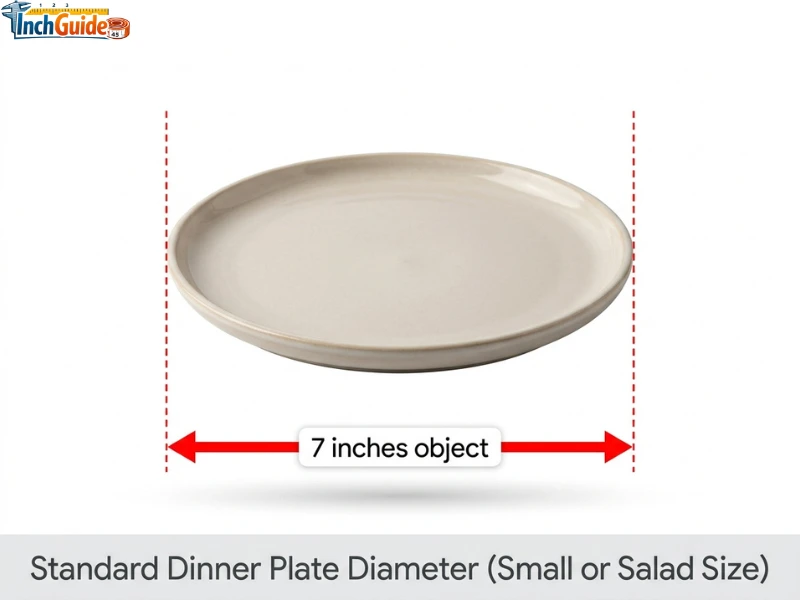
A small dinner plate or salad plate can be close to seven inches across. Current size references commonly place salad and dessert plates around the 7- to 8.5-inch range, depending on the product and dinnerware style.
The seven-inch measurement here is a diameter, not a straight length along the plate’s edge.
To picture it, imagine placing a ruler across the center of the plate. If the distance from one rim to the opposite rim is seven inches, the plate has a 7-inch diameter.
This is a useful example because it shows why “seven inches” does not always mean an object is seven inches long. A circular plate can be seven inches across even though its circumference is much larger.
10. Standard Hot Dog or Dinner Sausage
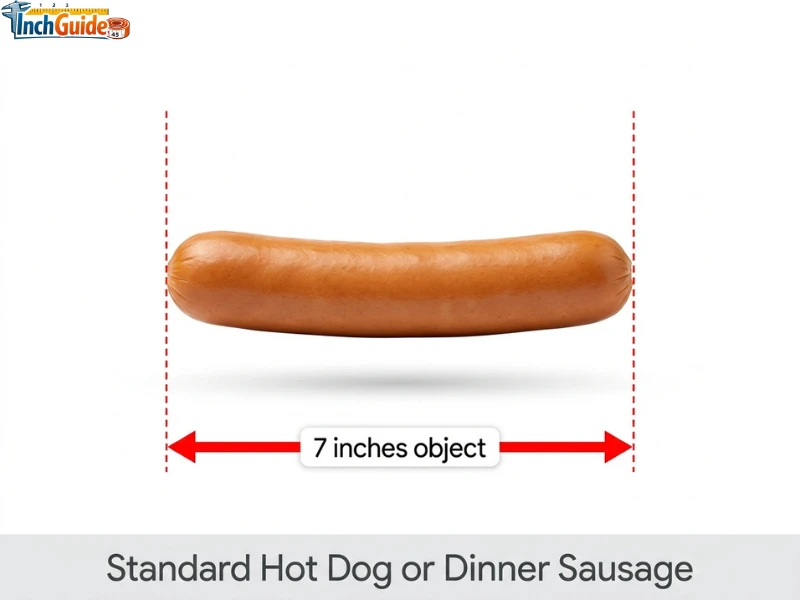
A standard hot dog or dinner sausage can also be a useful approximate reference for seven inches, especially when comparing longer sausage varieties.
However, this is one of the less precise objects in the list. Sausages come in many lengths and diameters, and their size changes depending on the product, manufacturer, and type.
If you have a sausage that measures around seven inches from end to end, it provides a simple food-based reference. You can place it beside a ruler before cooking if you want to see how close it actually is.
For example, a seven-inch sausage gives you a straight object that is easy to compare visually. But unlike a 7-inch vinyl record or a fixed-size photo, it should never be treated as a standardized seven-inch measurement.
Seven Inches on a Ruler
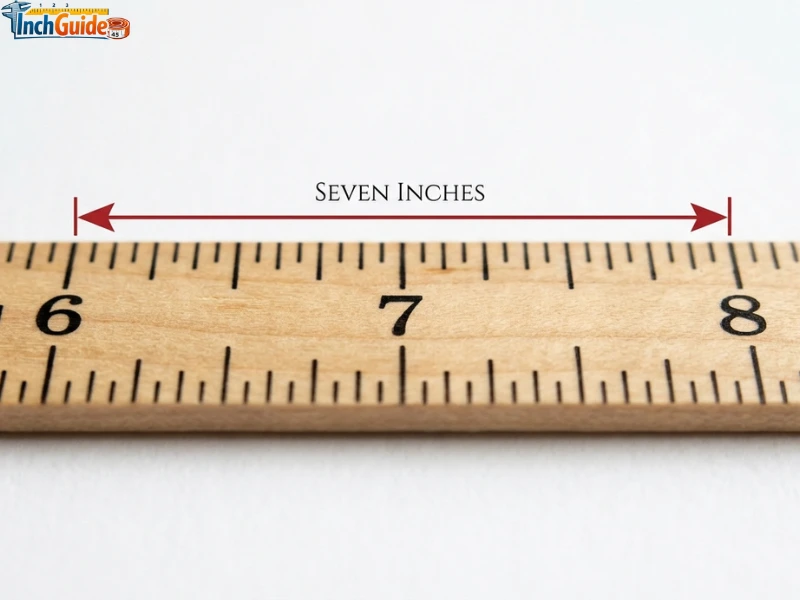
Finding seven inches on a ruler is straightforward. On a standard 12-inch ruler, start at zero and move to the mark labeled 7.
The seven-inch point is one inch beyond the exact halfway point. Since six inches is the midpoint of a 12-inch ruler, the 7-inch mark is just to its right.
On the metric side, seven inches corresponds to 17.78 cm. So you would find it between 17 and 18 cm, very close to the 18 cm mark.
If you are using a ruler with only whole-centimeter markings, you may not see an exact 17.78 cm line. In that situation, seven inches is approximately 18 cm for a quick visual estimate.
See Also: How Long Is 13 Inches
Seven Inches Compared With Nearby Measurements
Looking at nearby sizes can make seven inches easier to understand.
| Measurement | Relationship to 7 Inches |
|---|---|
| 5 inches | 2 inches shorter |
| 6 inches | 1 inch shorter |
| 7 inches | Reference size |
| 8 inches | 1 inch longer |
| 10 inches | 3 inches longer |
| 12 inches | 5 inches longer |
The jump from 6 to 7 inches is only one inch, but that difference becomes easy to notice when the two lengths are placed side by side.
Seven inches is also 58.3% of a foot. So it has passed the halfway point but is still considerably shorter than a complete foot.
Is 7 Inches Close to 18 Centimeters?
Yes. Seven inches is very close to 18 centimeters.
The exact value is 17.78 cm, while 18 cm is only 0.22 cm longer. In millimeters, that difference is 2.2 mm.
For rough visual comparisons, treating seven inches as approximately 18 cm is usually easy to understand. For precise measurements, keep the exact value of 17.78 cm.
This small difference is why someone familiar with metric measurements may naturally think of seven inches as “about 18 centimeters.”
Seven Inches Is Not Always the Same Type of Measurement
One of the easiest mistakes is assuming that seven inches always describes an object’s overall length.
It might instead describe:
- Diameter: the distance across a circular object.
- Diagonal: the distance from one corner to another.
- Height: the vertical dimension of an object.
- Width: the horizontal dimension.
- Depth: how far an object extends from front to back.
- Overall length: the distance from one end to the other.
The 7-inch vinyl record is a good diameter example. A small tablet with a 7-inch display is a diagonal example. A paperback book can have a height close to seven inches.
These are all different ways of using the same unit.
How to Picture 7 Inches Without a Measuring Tape
You do not need to memorize ten objects to estimate seven inches. It is better to choose one or two references that you actually have access to.
A few useful methods are:
- Picture the diameter of a 7-inch vinyl record.
- Think about the height of a compact paperback book.
- Compare the length with a dinner fork.
- Use a hairbrush that you have already measured.
- Think of a new pencil as slightly longer than seven inches.
- Use a 7-inch screen diagonal as a digital reference.
The most reliable method is to measure your chosen object once. After that, you know whether it is slightly shorter, equal to, or longer than seven inches.
This is much better than assuming every object described online as “about seven inches” has the same dimensions.
When 7 Inches Matters in Everyday Life
Seven-inch measurements appear in more places than you might expect.
You may encounter them when looking at the dimensions of books, small electronics, kitchenware, grooming products, craft supplies, records, and other household items.
The number can also appear in product descriptions where the measurement is not immediately obvious. A manufacturer may give a seven-inch diameter rather than a seven-inch length.
This is why reading the complete specification matters. If an online listing says “7 inches,” check whether it means length, width, height, depth, diameter, or screen diagonal.
That one detail can make a major difference when you are deciding whether something will fit into a drawer, shelf, bag, frame, or storage space.
Common Mistakes When Estimating 7 Inches
There are a few easy mistakes to avoid.
- Confusing inches with centimeters: 7 inches is 17.78 cm, not 7 cm.
- Calling every pencil exactly 7 inches: a new unsharpened pencil can be closer to 7.5 inches.
- Ignoring diameter: a 7-inch plate measures seven inches across its diameter, not seven inches around its edge.
- Confusing screen size with device height: a 7-inch display is measured diagonally.
- Assuming food is standardized: carrots and sausages can vary considerably.
- Measuring only part of an object: a pair of scissors or hairbrush should be measured across its complete length when using it as an overall reference.
These details help keep a visual comparison useful without turning an approximate object into a false exact measurement.
A Simple Way to Remember Seven Inches
If you want one mental shortcut, start with a foot.
A foot is 12 inches. Half of that is 6 inches. Add one more inch and you arrive at seven inches.
In metric terms, remember that 7 inches is 17.78 cm, which is just under 18 cm.
For a physical reference, the seven-inch vinyl record is especially useful because its nominal diameter gives you a clear seven-inch circle. For everyday objects, a paperback, dinner fork, hairbrush, or pencil can provide a rough visual comparison.
Once you have seen seven inches beside a ruler a few times, the measurement becomes much easier to recognize.
Explore our inches measurement guides for more practical size comparisons.
FAQs
How many centimeters are 7 inches?
Seven inches equals 17.78 centimeters. For quick estimation, you can round it to approximately 18 cm.
How many millimeters are 7 inches?
Seven inches equals 177.8 millimeters. This is only 2.2 mm shorter than 180 mm.
How many feet is 7 inches?
Seven inches equals 0.5833 feet, which is slightly more than half a foot.
Is 7 inches longer than half a foot?
Yes. Half a foot is exactly 6 inches, so seven inches is one inch longer than half a foot.
What object is exactly 7 inches?
A traditional 7-inch vinyl record provides one of the clearest exact seven-inch references because the format’s nominal diameter is seven inches.
Is 7 inches the same as 18 cm?
Not exactly. Seven inches equals 17.78 cm, so 18 cm is 0.22 cm, or 2.2 mm, longer.
How can I visualize 7 inches without a ruler?
You can use familiar objects such as a compact paperback book, dinner fork, hairbrush, or a full-length pencil as approximate references. For a more exact reference, a 7-inch vinyl record gives a fixed seven-inch diameter.
What does 7 inches look like on a ruler?
On a standard 12-inch ruler, the 7-inch mark is one inch beyond the midpoint. On a metric ruler, seven inches falls at 17.78 cm, just before the 18 cm mark.
Conclusion
Seven inches sits in a useful middle ground. It has moved beyond the six-inch midpoint of a foot, but it is still noticeably shorter than 12 inches.
The exact measurement is 17.78 cm, or 177.8 mm, and that number becomes much easier to remember once you attach it to something familiar.
A 7-inch vinyl record gives you a fixed circular reference. A paperback, dinner fork, hairbrush, pencil, scissors, carrot, or sausage can provide a more casual everyday comparison. A small tablet shows something different again because its seven-inch specification may describe a diagonal screen measurement.
So when you need to picture 7 inches, do not rely on one object alone. Think about the type of measurement first, then use a familiar reference that matches it. For precise work, confirm the distance with a ruler or measuring tape.