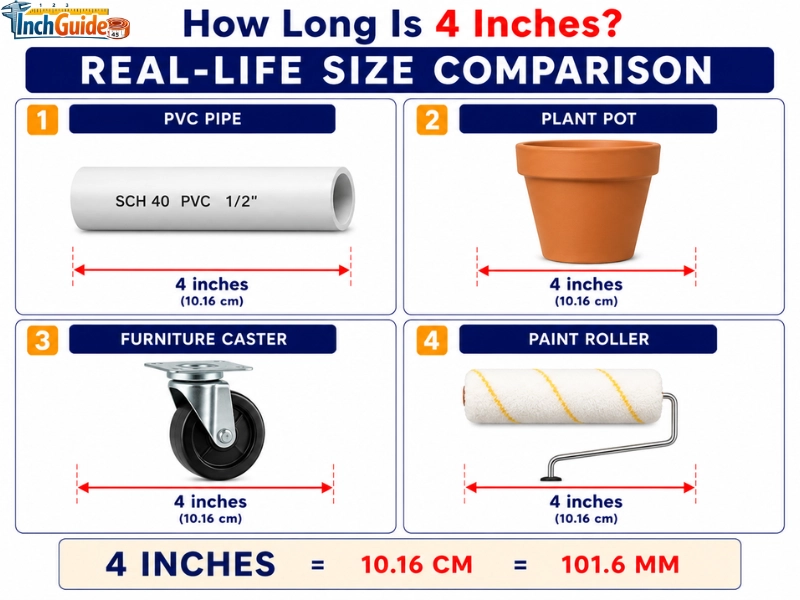

Four inches is exactly 10.16 centimeters (cm), 101.6 millimeters (mm), or one-third of a foot. While the conversion is simple, many people still struggle to picture what this length actually looks like in everyday life.
Whether you’re buying a product online, working on a DIY project, reading package dimensions, or comparing measurements, understanding how long 4 inches really is can help you make better decisions without constantly reaching for a ruler.
Instead of relying only on conversions, this guide explains where you’ll encounter 4 inches, how it compares with familiar measurements, and why this small length is more common than you might think.
Quick Fact
Since 1 inch equals exactly 2.54 centimeters, multiplying it by four gives:
4 inches = 10.16 centimeters
This is the exact metric equivalent used worldwide.
Understanding 4 Inches at a Glance
Sometimes the quickest way to understand a measurement is to see it in different units.
| Measurement Unit | Equivalent of 4 Inches |
| Inches | 4 in |
| Centimeters | 10.16 cm |
| Millimeters | 101.6 mm |
| Meters | 0.1016 m |
| Feet | 0.333 ft (1/3 foot) |
| Yards | 0.111 yd |
Why Is 4 Inches a Surprisingly Useful Measurement?
Some measurements appear frequently because manufacturers, designers, and builders use them as standard reference sizes.
Four inches is one of those measurements.
You may notice it when shopping for home accessories, choosing craft supplies, checking electronic accessories, buying kitchen tools, or comparing product dimensions online.
Unlike very small measurements, 4 inches is long enough to be noticeable but still compact enough to fit comfortably in one hand. That makes it a common size for countless everyday products.
Understanding this length also helps you avoid mistakes when switching between the imperial and metric measurement systems, especially if you’re more familiar with centimeters than inches.
Seeing 4 Inches Without a Measuring Tape
Numbers alone rarely help people visualize a length.
Instead of memorizing 10.16 cm, it is easier to understand how 4 inches occupies physical space.
Imagine a straight line beginning at zero and ending exactly four inches away.
It is:
- longer than a standard golf tee
- noticeably shorter than a smartphone
- roughly one-third of a standard 12-inch ruler
- slightly longer than 10 centimeters
These comparisons help build a mental picture before you even pick up a ruler.
The goal isn’t to replace accurate measuring tools—it is to make estimating easier when one isn’t available.
Why 4 Inches Feels Different From 10 Centimeters
Many people assume 4 inches and 10 centimeters are the same because both numbers seem similar.
In reality, they are different.
- 4 inches = 10.16 cm
- 10 cm = 3.94 inches
That difference may seem tiny, but it matters when you’re cutting materials, fitting replacement parts, sewing fabric, or following construction measurements.
For everyday estimating, you can think of 4 inches as just over 10 centimeters.
For precision work, always use the exact conversion of 10.16 cm.
When Does a 4-Inch Difference Actually Matter?
A difference of four inches can completely change whether something fits.
Consider these examples:
- A storage container that’s four inches taller may no longer fit on a shelf.
- A picture frame with four extra inches can dramatically change wall spacing.
- Four additional inches on a drawer organizer may prevent it from fitting inside a cabinet.
- A garden planter that’s four inches deeper holds significantly more soil than a shallower one.
This shows why understanding measurements isn’t only about numbers—it’s about making practical decisions before buying or building.
4 Inches Compared With Other Common Measurements
Comparisons make unfamiliar measurements much easier to understand.
| Measurement | Difference |
| 1 inch | Four times shorter than 4 inches |
| 2 inches | Half of 4 inches |
| 3 inches | One inch shorter |
| 4 inches | Reference measurement |
| 5 inches | One inch longer |
| 6 inches | One and a half times longer |
| 10 centimeters | Slightly shorter than 4 inches |
Looking at nearby measurements helps you estimate sizes more confidently, especially when reading product specifications or comparing dimensions online.
Where You’ll Commonly Encounter a 4-Inch Measurement
Even if you don’t realize it, four inches appears in many everyday situations.
You may come across it while:
- comparing small home décor items
- shopping for storage accessories
- selecting craft materials
- checking kitchen utensils
- reading packaging dimensions
- choosing hardware components
- measuring spaces for organizers
- planning DIY projects
Because it is neither extremely small nor particularly large, 4 inches is one of the most practical everyday measurements used in homes, workshops, schools, and offices.
Why Learning Measurements Is Better Than Memorizing Numbers
Many people remember that 4 inches equals 10.16 centimeters, but quickly forget the number because it lacks context.
A better approach is to connect the measurement with situations you experience regularly.
When you understand where 4 inches appears, how it compares with nearby sizes, and when small differences matter, remembering the measurement becomes much easier.
Instead of memorizing a conversion, you begin recognizing the size naturally whenever you see similar dimensions.
Make Sense of 4 Inches Through Everyday References
The easiest way to picture 4 inches is by comparing it with familiar objects. However, not every object that looks close to 4 inches actually measures that length. Some are manufactured to a stated size, while others vary depending on the brand or model.
To avoid confusion, the comparisons below are divided into exact references and approximate visual references.
Exact vs. Approximate: Which References Can You Trust?
When estimating measurements, it’s important to know whether you’re looking at a standardized size or simply making a visual comparison.
| Exact Reference | Approximate Reference |
| Manufactured to a stated size | Natural size variation |
| Reliable for measuring | Good for quick visualization |
| Consistent across products | May differ by brand or model |
| Better for accuracy | Better for estimation |
Whenever precision matters, rely on a ruler or an item that is specifically manufactured to the stated measurement.
6 Everyday References That Help You Visualize 4 Inches
These examples make it easier to understand how much space four inches occupies. They are meant to improve visualization rather than replace proper measuring tools.
1. PVC Pipe
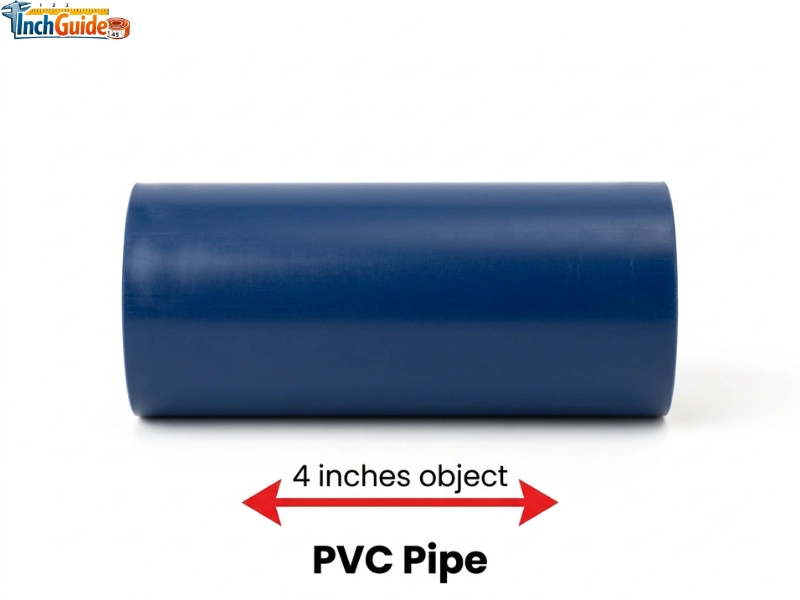
Many plumbing supplies are sold by their nominal size, and a 4-inch PVC pipe is one of the most common options used in drainage systems.
If you look directly at the circular opening, it gives you a strong visual impression of how wide four inches is. Although the actual outside diameter differs depending on the pipe standard, a product labeled as a 4-inch pipe is a familiar reference for understanding this measurement.
This comparison is especially useful for anyone working on home improvement or plumbing projects.
2. Plant Pot
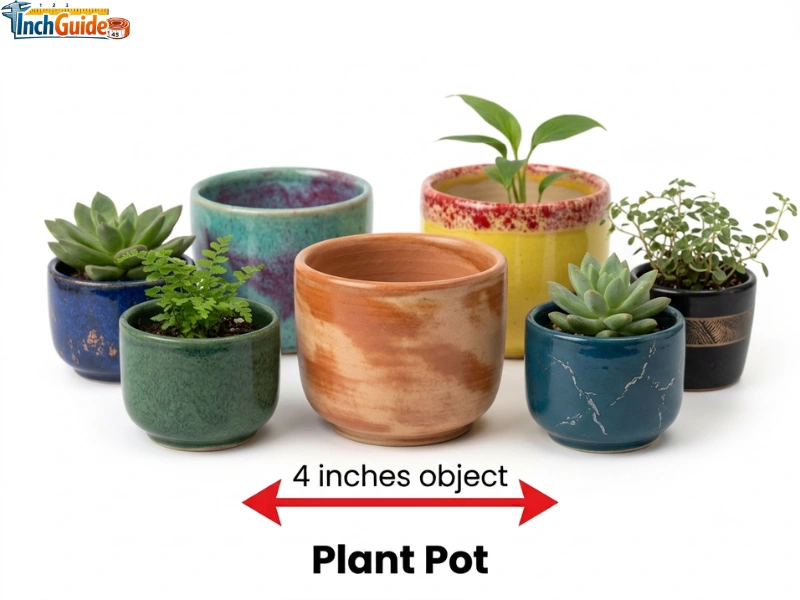
Small indoor plants are often sold in 4-inch nursery pots.
The measurement refers to the diameter across the top of the container, making it an excellent example of a standardized product size that many gardeners recognize.
If you’ve ever purchased herbs, succulents, or small flowering plants, you’ve probably handled a 4-inch pot without paying much attention to its dimensions.
3. Furniture Caster
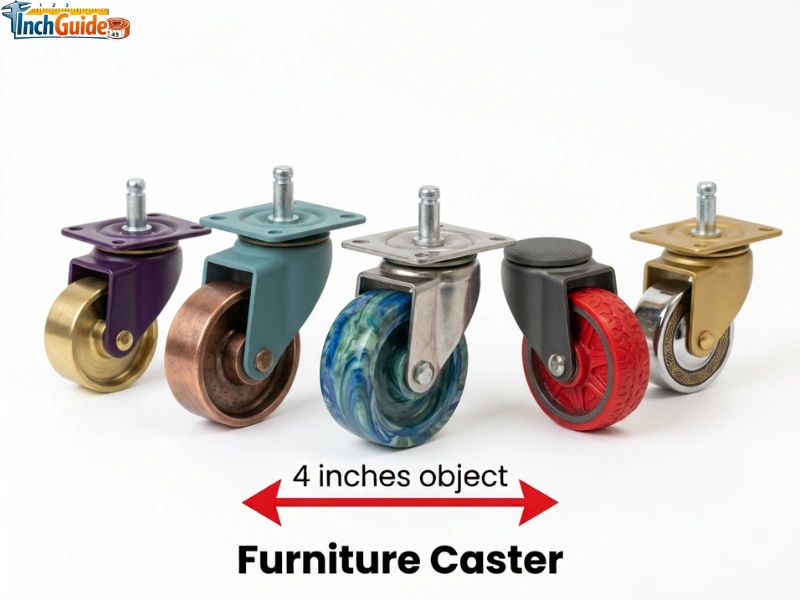
Some heavy-duty furniture and equipment casters are manufactured with 4-inch wheels.
The wheel’s diameter provides a clear idea of the measurement and also shows how four inches looks in a practical setting where size directly affects movement and stability.
Because wheel sizes are clearly labeled by manufacturers, they make more dependable references than randomly chosen household objects.
4. Ceramic Tile
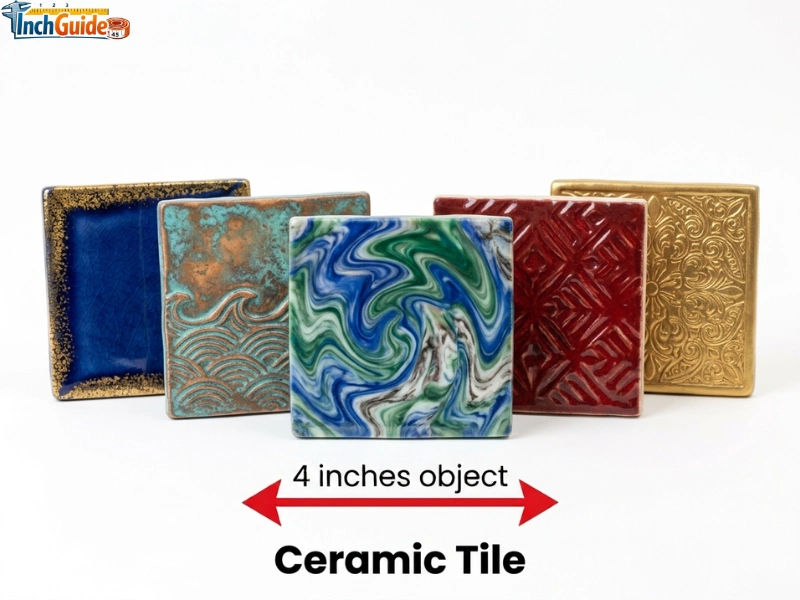
Many tile manufacturers provide 4 × 4-inch ceramic tile samples for kitchens, bathrooms, and renovation projects.
Holding one in your hand instantly demonstrates both the length and width of four inches.
Unlike irregular household items, a size-labeled tile sample offers a consistent visual reference.
5. Paint Roller
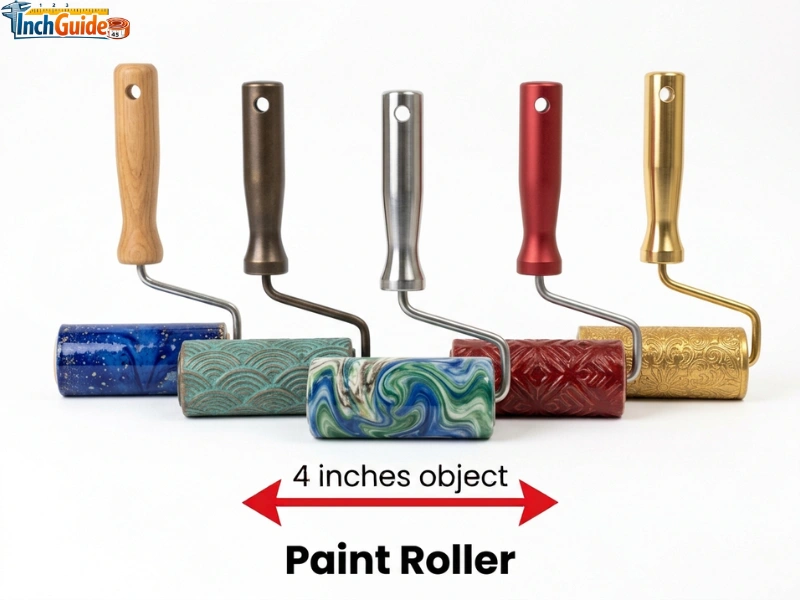
Mini paint rollers are widely available in a 4-inch width.
These rollers are commonly used for painting cabinets, trim, shelves, furniture, and narrow surfaces where a larger roller would be difficult to control.
Since the roller width is specified by the manufacturer, it provides another practical way to understand the measurement.
6. Cabinet Pull
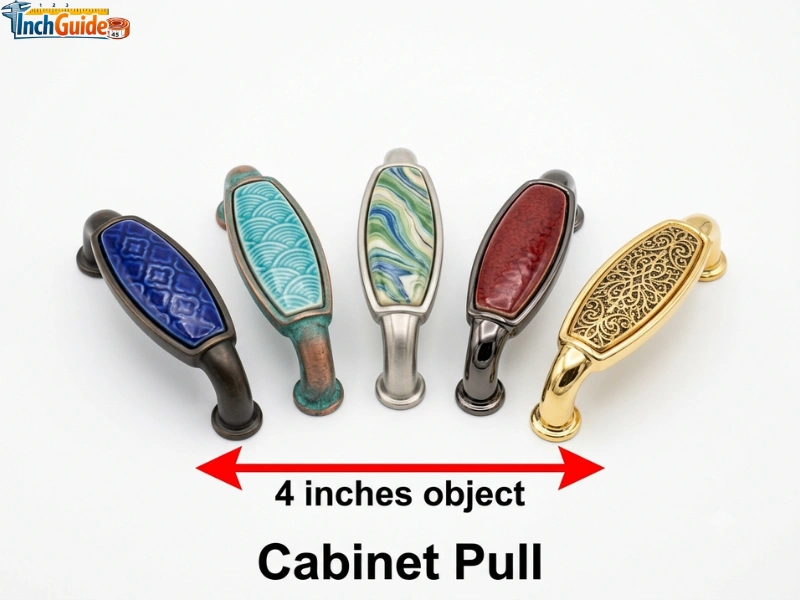
Cabinet hardware is available in many sizes, and some decorative cabinet pulls measure approximately 4 inches from end to end.
Although mounting-hole spacing and overall length are different measurements, checking the manufacturer’s specifications allows you to use a labeled 4-inch pull as a visual guide.
This comparison is particularly useful when renovating kitchens or replacing cabinet hardware.
Why Exact Measurements Matter More Than Visual Estimates
Looking at familiar objects helps build a mental picture, but visual estimation has limits.
For example, two items may appear nearly identical in size while differing by several millimeters. That small difference may not matter when estimating the length of a decorative object, but it can become important when:
- cutting wood or plastic
- installing shelves
- fitting replacement parts
- sewing fabric
- purchasing storage containers
- ordering hardware online
If accuracy affects the final result, always confirm the measurement with a ruler or tape measure rather than relying only on visual comparisons.
How to Estimate 4 Inches Without a Ruler
If you don’t have a ruler nearby, there are still several ways to estimate four inches.
Use a Product With a Known Size
Items such as a 4-inch plant pot, 4-inch paint roller, or another product labeled with its dimensions provide a convenient reference.
Always verify the product size before using it as a measuring guide.
Measure in Centimeters
If you only have a metric ruler, measure 10.16 centimeters.
For quick estimates, about 10.2 cm is close enough for most everyday situations, but use 10.16 cm whenever precision matters.
Compare With Nearby Measurements
If you’re familiar with smaller inch measurements:
- 2 inches is half of 4 inches.
- 3 inches is slightly shorter.
- 5 inches is only one inch longer.
Thinking in relative sizes often makes estimation easier than remembering conversion numbers.
Common Mistakes People Make With 4-Inch Measurements
Even simple measurements can lead to mistakes if they are interpreted incorrectly.
Some of the most common errors include:
- Starting from the edge of the ruler instead of the zero mark.
- Confusing 4 centimeters with 4 inches.
- Assuming every similar-looking object is exactly 4 inches.
- Ignoring manufacturer specifications when using household items as references.
- Estimating instead of measuring when precision is required.
Avoiding these mistakes can save time and prevent costly errors in DIY projects, shopping, and home improvement tasks.
Practical Situations Where Knowing 4 Inches Helps
Understanding the actual size of 4 inches is useful in more places than most people realize. Even if you rarely measure objects yourself, you’ll often see this dimension when shopping, decorating, or completing small projects.
Here are some everyday situations where knowing what 4 inches looks like can save time and help you make better decisions.
Shopping for Home Products
Many online product listings include measurements in inches. If a storage basket, desk organizer, plant pot, or decorative item is listed as 4 inches wide or tall, you can quickly judge whether it will fit your available space.
Visualizing the measurement before purchasing also reduces the chance of ordering something that is larger or smaller than expected.
DIY and Home Improvement
Whether you’re installing shelves, replacing cabinet hardware, or planning a small repair, a difference of four inches can affect the final result.
Understanding this measurement helps you estimate spacing, choose the correct materials, and avoid unnecessary adjustments during installation.
Crafts and Creative Projects
Crafting often involves precise measurements. Paper cutting, fabric projects, scrapbooking, and handmade decorations commonly require small dimensions where accuracy matters.
Recognizing the size of four inches allows you to work more confidently before making permanent cuts or adjustments.
Organizing Small Spaces
Drawer organizers, storage boxes, desk accessories, and kitchen organizers frequently include dimensions close to four inches.
Knowing this measurement helps you compare products more easily and determine whether they’ll fit inside cabinets, drawers, or shelves.
Comparing 4 Inches With Nearby Measurements
Understanding nearby measurements makes it much easier to estimate four inches in everyday situations.
| Measurement | Metric Equivalent | Compared With 4 Inches |
| 2 inches | 5.08 cm | Half as long |
| 3 inches | 7.62 cm | 1 inch shorter |
| 4 inches | 10.16 cm | Reference measurement |
| 5 inches | 12.7 cm | 1 inch longer |
| 6 inches | 15.24 cm | 2 inches longer |
This comparison also helps when reading dimensions on product packaging or technical specifications.
Continue exploring with our related measurement guides below.
FAQs
Is 4 inches exactly 10 centimeters?
No.
Four inches equals 10.16 centimeters, making it slightly longer than 10 centimeters.
How many millimeters are in 4 inches?
There are 101.6 millimeters in exactly four inches.
Where is 4 inches on a ruler?
Locate the 0 mark and move to the line labeled 4. The distance between these two marks is exactly four inches.
Is 4 inches one-third of a foot?
Yes.
Since one foot contains 12 inches, four inches equals exactly one-third of a foot.
Why do online products often use inches?
Many manufacturers, especially in countries using the imperial system, list dimensions in inches. Understanding common inch measurements makes product sizes easier to visualize before purchasing.
What’s the easiest way to remember 4 inches?
Remember this simple conversion:
4 inches = 10.16 cm = 101.6 mm
Thinking of it as just over 10 centimeters makes it easier to picture.
Can everyday objects replace a ruler?
They can help you estimate a measurement, but they should not replace a ruler when accuracy is important. Manufactured products with labeled dimensions are generally more reliable than ordinary household objects.
When should I use an exact measurement instead of an estimate?
Always use an exact measurement for tasks such as construction, woodworking, sewing, product fitting, or any project where even a small difference could affect the outcome.
Conclusion
Four inches is exactly 10.16 centimeters (101.6 millimeters), making it a practical measurement that appears in many everyday situations. Rather than memorizing the conversion alone, it is more useful to understand how this length fits into real life, how it compares with nearby measurements, and when precision matters.
Whether you’re shopping online, completing a DIY project, organizing your home, or working on a craft, recognizing the size of 4 inches allows you to make quicker and more confident decisions. The more often you relate this measurement to real-world situations, the easier it becomes to estimate accurately—even without a ruler.